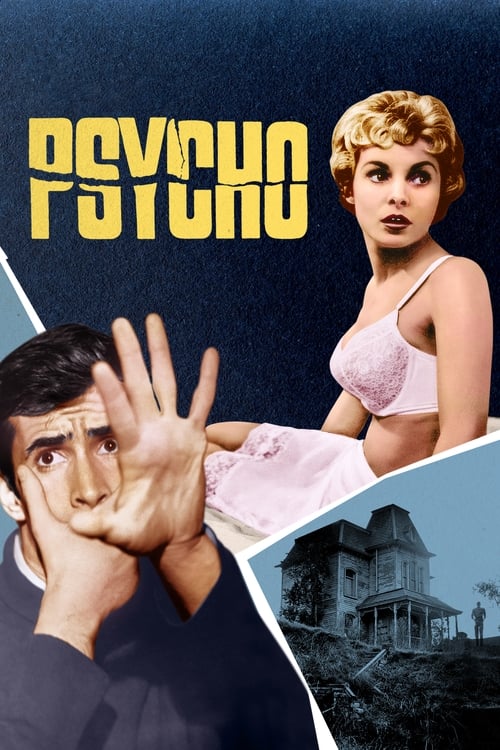
|
|
| Line 1: |
Line 1: |
| | | {{Infobox horror film |
| {{Use American English|date=September 2019}}
| | |title=Psycho |
| | | |director=Alfred Hitchcock |
| {{Infobox film | | |writer=Joseph Stefano |
| | name = Psycho | | |producer=Alfred Hitchcock |
| | image = Psycho (1960) theatrical poster (retouched).jpg
| | |starring=Anthony Perkins / Janet Leigh / Vera Miles / John Gavin / Martin Balsam / John McIntire / Simon Oakland / Frank Albertson |
| | alt = The names of the main actors are featured down the right side of the poster. The poster features a large image of Janet Leigh. Smaller images of Anthony Perkins and John Gavin are above the words, written in large print, "Alfred Hitchcock's Psycho".
| | |music=Bernard Herrmann |
| | caption = Theatrical release poster<br />by [[Macario Gómez Quibus]]<ref name=elpc>{{cite news|title=Muere Mac, el mítico cartelista de 'Doctor Zhivago' y 'Psicosis' |url=https://www.elperiodico.com/es/ocio-y-cultura/20180721/muere-mac-macario-gomez-cartelista-doctor-zhivago-quo-vadis-6955323
| | |cinematography=John L. Russell |
| |work=[[El Periódico de Catalunya]] |language=es |date=July 21, 2018 |access-date=August 18, 2018 |archive-url=https://web.archive.org/web/20180727181224/https://www.elperiodico.com/es/ocio-y-cultura/20180721/muere-mac-macario-gomez-cartelista-doctor-zhivago-quo-vadis-6955323 |archive-date=July 27, 2018 |url-status=live}}</ref>
| | |editing=George Tomasini |
| | director = [[Alfred Hitchcock]] | | |studio=Shamley Productions |
| | screenplay = [[Joseph Stefano]] | | |released=1960-06-22 |
| | based_on = {{based on|''[[Psycho (novel)|Psycho]] ''|[[Robert Bloch]]}}
| | |runtime=109 minutes |
| | producer = Alfred Hitchcock | | |country=United States of America |
| | starring = {{Plain list| | | |language=English |
| * [[Anthony Perkins]]
| | |budget=$806,947 |
| * [[Vera Miles]]
| | |gross=$50,048,065 |
| * [[John Gavin]]
| |
| * [[Martin Balsam]]
| |
| * [[John McIntire]]
| |
| * [[Janet Leigh]]
| |
| }}
| |
| | cinematography = [[John L. Russell (cinematographer)|John L. Russell]] | |
| | editing = [[George Tomasini]] | |
| | music = [[Bernard Herrmann]]
| |
| | studio = Shamley Productions | |
| | distributor = [[Paramount Pictures]]{{efn|name=Paramount|After the film's release, Paramount transferred the film rights to Hitchcock, who later sold the distribution rights to [[Universal Pictures]] in 1962.<ref>{{cite web|title=Psycho (1960): Notes|url=https://www.tcm.com/tcmdb/title/24944/psycho#notes|archive-url=https://web.archive.org/web/20111006172251/http://www.tcm.com/tcmdb/title/24944/Psycho/#notes|url-status=dead|archive-date=October 6, 2011|website=Turner Classic Movies|access-date=April 25, 2017}}</ref>}} | |
| | released = {{Film date|1960|06|16|New York City|ref1=<ref name=AFI />|1960|09|08|United States|ref2=<ref>{{Cite web |last=Hedrick |first=Lizzie |date=September 8, 2015 |title=8 Reasons Psycho Taps into the Psyche |url=http://dornsifelive.usc.edu/news/stories/2140/8-reasons-psycho-taps-into-the-psyche/ |access-date=June 17, 2020 |website=[[USC Dornsife]] |archive-date=June 18, 2020 |archive-url=https://web.archive.org/web/20200618131821/http://dornsifelive.usc.edu/news/stories/2140/8-reasons-psycho-taps-into-the-psyche/ |url-status=live}}</ref>}}<!--- Per [[WP:FILMRELEASE]] --->
| |
| | runtime = 109 minutes | |
| | country = United States<ref name="BFI">{{cite web |title=Psycho (1960) |work=BFI |url=http://explore.bfi.org.uk/4ce2b6b39fc24 |publisher=[[British Film Institute]] |access-date=December 30, 2014 |archive-url=https://web.archive.org/web/20150116084156/http://explore.bfi.org.uk/4ce2b6b39fc24 |archive-date=January 16, 2015 }}</ref> | |
| | language = English | |
| | budget = $806,947<ref name="Mojo">{{cite web |title=Psycho (1960) |url=https://boxofficemojo.com/movies/?id=psycho.htm|website=[[Box Office Mojo]] |access-date=October 20, 2014}}</ref> | |
| | gross = $50 million<ref name="Nixon">{{cite web |last=Nixon |first=Rob |title=The Critics' Corner: PSYCHO |url=https://www.tcm.com/this-month/article/191165 |publisher=[[Turner Classic Movies]] |access-date=December 30, 2014 |archive-date=December 30, 2014 |archive-url=https://web.archive.org/web/20141230211956/http://www.tcm.com/this-month/article/191165%7c0/Critics-Corner-Psycho.html |url-status=live}}</ref> | |
| }} | | }} |
| '''''Psycho''''' is a 1960 American [[horror film]] <!-- Please do not alter the genre without discussing on the Talk page-->produced and directed by [[Alfred Hitchcock]]. The screenplay, written by [[Joseph Stefano]], was based on the 1959 [[Psycho (novel)|novel of the same name]] by [[Robert Bloch]]. The film stars [[Anthony Perkins]], [[Janet Leigh]], [[Vera Miles]], [[John Gavin]] and [[Martin Balsam]]. The plot centers on an encounter between on-the-run embezzler [[Marion Crane]] (Leigh), shy [[motel]] proprietor [[Norman Bates]] (Perkins) and his disturbed mother. A private investigator (Balsam), Marion's lover Sam Loomis (Gavin) and her sister [[Lila Crane|Lila]] (Miles) investigate her disappearance.<ref>{{Cite web|url=https://www.tcm.com/tcmdb/title/24944/psycho#synopsis|title=Psycho (1960) – Full Synopsis|publisher=[[Turner Classic Movies]]|access-date=June 16, 2018|archive-date=June 16, 2018|archive-url=https://web.archive.org/web/20180616053629/http://www.tcm.com/tcmdb/title/24944/Psycho/full-synopsis.html|url-status=dead}}</ref>
| |
|
| |
|
| ''Psycho'' was seen as a departure from Hitchcock's previous film, ''[[North by Northwest]]'' (1959), as it was filmed on a small budget in black-and-white by the crew of his television series ''[[Alfred Hitchcock Presents]]''. Initially, the film divided critics due to its controversial subject matter, but audience interest and outstanding box-office returns prompted a major critical re-evaluation. ''Psycho'' was a massive commercial success; from a budget of $806,947 ($6.2 million with 2025 inflation),<ref>{{cite web|url=https://www.in2013dollars.com/us/inflation/1972?amount=806947|title=$806,947 with 2025 inflation|website=Dollar inflation|access-date=20 July 2025}}</ref> the film gained $50 million ($384.5 million with 2025 inflation) at the box office, worldwide, not including the money made with rentals.<ref>{{cite web|url=https://www.in2013dollars.com/us/inflation/1972?amount=50000000|title=$50 million in 1960 with 2025 inflation|website=Dollar inflation|access-date=20 July 2025}}</ref> ''Psycho'' was nominated for four [[33rd Academy Awards|Academy Awards]], including [[Academy Award for Best Director|Best Director]] for Hitchcock and [[Academy Award for Best Supporting Actress|Best Supporting Actress]] for Leigh. | | '''Psycho''' (1960) is a horror / thriller / mystery film directed by Alfred Hitchcock. |
|
| |
|
| ''Psycho'' is now considered one of Hitchcock's best films,{{efn|name=AFI|''Psycho'' is the top listed Hitchcock film in ''The 100 Greatest Movies of All Time'' by ''[[Entertainment Weekly]]'', and the highest Hitchcock film on [[AFI's 100 Years...100 Movies]].}} and is arguably his most famous and influential work.<ref>{{Cite web|url=https://theconversation.com/psycho-turns-60-hitchcocks-famous-fright-film-broke-all-the-rules-140175|title=Psycho turns 60 – Hitchcock's famous fright film broke all the rules|website=[[The Conversation (website)|The Conversation]]|date=June 15, 2020|access-date=January 22, 2021|archive-date=December 17, 2020|archive-url=https://web.archive.org/web/20201217142643/http://theconversation.com/psycho-turns-60-hitchcocks-famous-fright-film-broke-all-the-rules-140175|url-status=live}}</ref> It has been hailed as a major work of cinematic art by international film critics and scholars who praise its slick direction, tense atmosphere, impressive camerawork, memorable score and iconic performances. Additionally, the [[Psycho shower scene|shower scene]] has become one of the best-known in all of cinema. It is regarded as "the most heavily analyzed film in the long career of the most investigated director in the history of American film"<ref>{{Cite book |last=Phillips |first=Kendall R. |title=Projected fears: horror films and American culture |date=2005 |publisher=Praeger |isbn=978-0-275-98353-6 |edition=1. publ |location=Westport, Conn. |pages=61}}</ref> and often ranked among [[List of films voted the best|the greatest films of all time]]. It set a new level of acceptability for violence, deviant behavior and sexuality in American films,<ref>{{cite web|url=https://rottentomatoes.com/m/psycho/|title=''Psycho'' reviews|access-date=April 17, 2010|website=[[Rotten Tomatoes]]|archive-date=March 23, 2010|archive-url=https://web.archive.org/web/20100323005502/http://www.rottentomatoes.com/m/psycho/|url-status=live}}</ref> and has been considered to be one of the earliest examples of the [[slasher film]] genre. After Hitchcock's death in 1980, [[Universal Pictures]] produced follow-ups: three [[Psycho (franchise)|sequels]], a [[Psycho (1998 film)|remake]], a [[Bates Motel (film)|made-for-television spin-off]] and a [[Bates Motel (TV series)|television series]]. In 1992, the [[Library of Congress]] deemed the film "culturally, historically, or aesthetically significant" and selected it for preservation in the United States [[National Film Registry]].<ref name=":0">{{Cite web|title=Complete National Film Registry Listing |url=https://www.loc.gov/programs/national-film-preservation-board/film-registry/complete-national-film-registry-listing/|website=Library of Congress|access-date=May 8, 2020|archive-date=October 31, 2016|archive-url=https://web.archive.org/web/20161031213743/https://www.loc.gov/programs/national-film-preservation-board/film-registry/complete-national-film-registry-listing/|url-status=live}}</ref><ref>{{Cite web|last1=Marx|first1=Andy|last2=Wharton|first2=Dennis|date=December 4, 1992|title=Diverse pix mix picked|url=https://variety.com/1992/film/news/diverse-pix-mix-picked-101808/|access-date=August 4, 2020|work=Variety|archive-date=August 4, 2020|archive-url=https://web.archive.org/web/20200804173846/https://variety.com/1992/film/news/diverse-pix-mix-picked-101808/|url-status=live}}</ref>
| | == Synopsis == |
| | | When larcenous real estate clerk Marion Crane goes on the lam with a wad of cash and hopes of starting a new life, she ends up at the notorious Bates Motel, where manager Norman Bates cares for his housebound mother. |
| == Plot ==
| |
| <!-- Per WP:FILMPLOT plot summaries for featured film articles should be 400-700 words -->
| |
| [[Marion Crane]], a real estate secretary in [[Phoenix, Arizona]], steals $40,000 in cash from her employer after hearing her boyfriend, Sam Loomis, complain that his debts are delaying their marriage. She sets off to drive to Sam's home in the town of Fairvale, California, switching cars in [[Bakersfield]] after an encounter with a suspicious policeman. A heavy rainstorm forces Marion to stop at the secluded Bates Motel just a few miles from Fairvale. [[Norman Bates]], the proprietor, whose [[Second Empire style]] house overlooks the motel, registers Marion (who uses an [[pseudonym|alias]]) and invites her to dinner with him in the motel's office. When Norman returns to his house to retrieve the food, Marion overhears him arguing with his mother about his desire to dine with Marion. After he returns, he discusses his hobby as a [[taxidermist]], his mother's "illness" and how people have a "private trap" they want to escape. When Marion suggests that Norman should have his mother institutionalized, he becomes greatly offended and insists that she is harmless.
| |
| | |
| Marion decides to drive back to Phoenix in the morning to return the stolen money. [[Psycho shower scene|As she showers, a shadowy figure enters the bathroom with a kitchen knife and stabs her to death.]] Shortly afterward, Norman is heard horrified at his mother's actions and rushes back to find Marion dead. He hurriedly cleans up the murder scene and places Marion's body, her belongings, and, unbeknownst to him, the hidden cash in her car, before sinking the vehicle in a [[swamp]].
| |
| | |
| Marion's sister, [[Lila Crane|Lila]], arrives in Fairvale a week later, tells Sam about the theft and demands information about Marion's whereabouts. He denies knowing anything about Marion's disappearance. A [[private investigator]] named Arbogast approaches them, stating that he has been hired to retrieve the money. He stops in at the Bates Motel and questions Norman, whose nervous conduct, stuttering, and inconsistent answers arouse his suspicion. Arbogast examines the [[guest register]] and discovers from some handwriting in it that Marion spent a night in the motel. When Arbogast infers from things Norman says that Marion had spoken to his mother, Arbogast asks to speak to her, but Norman refuses to allow it. Arbogast leaves, finds a pay phone, and calls Lila to tell her of his suspicions and that he will go back to the motel, speak to Norman's mother, and rejoin Lila in town later. When Arbogast returns and enters the Bates' house to search for Norman's mother, a shadowy figure at the top of the stairs ambushes him and slashes him around the head. He tumbles down the stairs as the figure stabs him repeatedly.
| |
| | |
| When Sam and Lila do not hear back from Arbogast, Sam goes to the motel to look for him. Sam spots a silhouette in the house who he assumes is Norman's mother, who is unresponsive to Sam's calls. Lila and Sam alert the local sheriff, Al Chambers, who tells them Norman's mother died in a murder–suicide by [[strychnine poisoning]] ten years before. Chambers suggests that Arbogast lied to Sam and Lila so he could pursue Marion and the money.
| |
| | |
| Convinced that something happened to Arbogast, Lila and Sam drive to the motel and check in. Sam distracts Norman in the office while Lila sneaks into the Bates' house. Suspicious, Norman knocks Sam out. As Norman heads to the house, Lila hides in the fruit cellar, where she discovers the [[mummified]] body of Norman's mother. Lila screams in horror, and Norman, wearing women's clothes and a wig, enters the cellar and attempts to attack her, only to be subdued by a recovered Sam.
| |
| | |
| At the police station, a psychiatrist explains to Lila, Sam, and Chambers that Norman killed his mother and her lover out of jealousy. Unable to bear the guilt, he stole his mother's corpse and treated it as if she were still alive, then re-created his mother as an [[alternate personality]], as jealous and possessive toward Norman as he felt about his mother. Whenever Norman was attracted to a woman, "Mother" would take over. Under the "Mother" personality, Norman killed two women before he killed Marion and Arbogast. The psychiatrist concludes that "Mother" has now completely submerged Norman's personality. Norman sits in a jail cell and hears his mother's voice stating the murders were his doing. Meanwhile, Marion's car, which contains her remains and the stolen money, is pulled from the swamp.
| |
|
| |
|
| == Cast == | | == Cast == |
| * [[Anthony Perkins]] as [[Norman Bates]] | | * [[Anthony Perkins]] as Norman Bates |
| * [[Vera Miles]] as [[Lila Crane]] | | * [[Janet Leigh]] as Marion Crane |
| | * [[Vera Miles]] as Lila Crane |
| * [[John Gavin]] as Sam Loomis | | * [[John Gavin]] as Sam Loomis |
| * [[Martin Balsam]] as Private Investigator Milton Arbogast | | * [[Martin Balsam]] as Milton Arbogast |
| * [[John McIntire]] as Deputy Sheriff Al Chambers | | * [[John McIntire]] as Al Chambers |
| * [[Simon Oakland]] as Dr. Richman | | * [[Simon Oakland]] as Fred Richman |
| * [[Frank Albertson]] as Tom Cassidy | | * [[Frank Albertson]] as Tom Cassidy |
| * [[Pat Hitchcock]] as Caroline | | * [[Patricia Hitchcock]] as Caroline |
| * [[Vaughn Taylor (actor)|Vaughn Taylor]] as George Lowery | | * [[Vaughn Taylor]] as George Lowery |
| * [[Lurene Tuttle]] as Mrs. Chambers | | * [[Lurene Tuttle]] as Mrs. Chambers |
| * [[John Anderson (actor)|John Anderson]] as California Charlie | | * [[John Anderson]] as California Charlie |
| * [[Mort Mills]] as Highway Patrol Officer | | * [[Mort Mills]] as Highway Patrol Officer |
| * [[Janet Leigh]] as [[Marion Crane]]<!-- Cast order per the opening credits, do NOT change --> | | * [[Fletcher Allen]] as Policeman on Steps (uncredited) |
| | | * [[Walter Bacon]] as Church Member (uncredited) |
| [[Virginia Gregg]], [[Paul Jasmin]] and [[Jeanette Nolan]] make uncredited appearances as the voice of [[Norma Bates (Psycho)|Norma "Mother" Bates]]. The three voices were used interchangeably, except for the speech in the final scene, which was performed entirely by Gregg.{{sfn|Nickens|Leigh|1996|p=83}}
| |
| | |
| == Production ==
| |
| === Development ===
| |
| ''Psycho'' is based on [[Robert Bloch]]'s 1959 [[Psycho (novel)|novel of the same name]], loosely inspired by the case of convicted [[Wisconsin]] murderer and grave robber [[Ed Gein]].<ref>{{Harvnb|Rebello|1990|pp=7–14}}</ref> Both Gein and the story's protagonist were solitary murderers in isolated rural locations. Each had deceased, domineering mothers, had sealed off a room in their home as a shrine to them. While Bates dressed in women's clothes, Gein dressed in the skins of the women he dug up. Gein was apprehended after killing twice.<ref>{{Harvnb|Reavill|2007|p=228}} "With only two confirmed kills, Ed did not technically qualify as a serial killer (the traditional minimum requirement was three)".</ref><ref>{{cite web | url=https://www.denofgeek.com/movies/the-real-texas-chainsaw-massacre-how-ed-gein-inspired-classic-horror-movies/ | title=The Real Texas Chainsaw Massacre: How ed Gein Inspired Classic Horror Movies | date=October 2018 }}</ref>
| |
| | |
| [[File:Psycho House, Motel and car composite.jpg|thumb|right|upright=1.59|The ''Psycho'' set on the [[Universal Studios Lot]], featuring a [[Ford Custom 300]] similar to that driven by [[Janet Leigh]] in the film, is now part of the studio tour at the [[Universal Studios Hollywood]] theme park.]]
| |
| [[Peggy Robertson]], Hitchcock's long-time assistant, read [[Anthony Boucher]]'s positive review of the novel in his "Criminals at Large" column in ''[[The New York Times]]'' and decided to show the book to her employer; however, studio readers at [[Paramount Pictures]] had already rejected its premise for a film.<ref name="auto">{{Harvnb|Rebello|1990|pp=19–20}}</ref> Hitchcock acquired rights to the novel for $9,500{{sfn|Nickens|Leigh|1996|p=6}} and reportedly ordered Robertson to buy all copies to preserve the novel's surprises.<ref name="auto" /> Hitchcock, who had come to face genre competitors whose works were critically compared to his own, was seeking new material to recover from two [[Alfred Hitchcock's unrealized projects|aborted projects]] with Paramount: ''Flamingo Feather'' and ''[[No Bail for the Judge]]''. He disliked stars' salary demands and trusted only a few people to choose prospective material, including Robertson.<ref>{{Harvnb|Rebello|1990|pp=18–19}}</ref>
| |
| | |
| Paramount executives balked at Hitchcock's proposal and refused to provide his usual budget.<ref name="Rebello23" /> In response, Hitchcock offered to film ''Psycho'' quickly and cheaply in black and white using the crew from his television series ''[[Alfred Hitchcock Presents]]''. Paramount executives rejected this cost-conscious approach, claiming their [[soundstage]]s were booked, but the industry was in a slump. Hitchcock countered that he personally would finance the project and film it at [[Universal-International]] using his Shamley Productions crew if Paramount would distribute. In lieu of his usual $250,000 director's fee, he proposed a 60% stake in the film negative. This combined offer was accepted, and Hitchcock went ahead in spite of naysaying from producer Herbert Coleman and Shamley Productions executive [[Joan Harrison (screenwriter)|Joan Harrison]].<ref>{{Harvnb|Rebello|1990|pp=26–29}}</ref>
| |
| | |
| === Screenplay ===
| |
| [[File:Universal Studios Hollywood 2012 44.jpg|thumb|right|A recreation of a scene from the film as part of the [[Universal Studios Hollywood|Universal]] [[Studio Tour]]]]
| |
| [[James P. Cavanagh]], a writer on ''Alfred Hitchcock Presents'', wrote the first draft of the screenplay.<ref name="dvddoc">''The Making of Psycho'', 1997 documentary directed by Laurent Bouzereau, Universal Studios Home Video, available on selected ''Psycho'' DVD releases.</ref> Hitchcock felt the script dragged and read like a television short horror story,{{sfn|Nickens|Leigh|1996|pp=36–37}} an assessment shared by an assistant.<ref name="dvddoc" /> Although [[Joseph Stefano]] had worked on only one film before, Hitchcock agreed to meet with him; despite Stefano's inexperience, the meeting went well and he was hired.<ref name="dvddoc" />
| |
| | |
| The screenplay is relatively faithful to the novel, with a few significant changes by Hitchcock and Stefano. Stefano found the character of Norman Bates unsympathetic—in the book, he is middle-aged, overweight and more overtly unstable—but became more intrigued when Hitchcock suggested casting Anthony Perkins.{{sfn|Nickens|Leigh|1996|pp=36–37}} Stefano eliminated Bates' [[alcoholism]],<ref name="Rebello 1990 39">{{Harvnb|Rebello|1990|p=39}}</ref> which necessitated removing Bates' "becoming" the mother personality when in a drunken stupor. Also removed was Bates' interest in [[Spiritualism (beliefs)|spiritualism]], the [[occult]] and [[pornography]].<ref>Tangentially mentioned by interviewer of Stefano [http://www.hitchcockwiki.com/wiki/Creative_Screenwriting_-_Interview_with_Joseph_Stefano Joseph Stefano] {{Webarchive|url=https://web.archive.org/web/20110930162013/http://www.hitchcockwiki.com/wiki/Creative_Screenwriting_-_Interview_with_Joseph_Stefano |date=September 30, 2011}} but generally given less attention than the film's omission of Bates' alcoholism and pornography.</ref> Hitchcock and Stefano elected to open the film with scenes in Marion's life and not introduce Bates at all until the twenty-minute mark, rather than open with Bates reading a history book as Bloch does.<ref name="Rebello 1990 39" /> Writer Joseph W. Smith observes that Marion's story "occupies only two of the novel's 17 chapters. Hitchcock and Stefano expanded this to nearly half the narrative".<ref>{{Harvnb|Smith|2009|p=15}}</ref>
| |
| | |
| Smith likewise mentions the absence of a hotel tryst between Marion and Sam in the novel. For Stefano, the conversation between Marion and Norman in the hotel parlor in which she displays maternal sympathy towards him makes it possible for the audience to switch their sympathies towards Norman after Marion's murder.<ref name="screenwriting-stefano">{{cite web |url=http://www.hitchcockwiki.com/wiki/Creative_Screenwriting_-_Interview_with_Joseph_Stefano |title=Interview in Creative ScreenWriting Journal. Reproduced at |publisher=Hitchcockwiki.com |access-date=January 26, 2014 |archive-date=January 19, 2014 |archive-url=https://web.archive.org/web/20140119052628/http://www.hitchcockwiki.com/wiki/Creative_Screenwriting_-_Interview_with_Joseph_Stefano |url-status=live}}</ref> When Lila is looking through Norman's bedroom in the film, she opens a book with a blank cover whose contents are unseen; in the novel, these are "pathologically pornographic" illustrations. Stefano wanted to give the audience "indications that something was quite wrong, but it could not be spelled out or overdone".<ref name="screenwriting-stefano" /> In his book of conversations with Hitchcock, [[François Truffaut]] says the novel "cheats" by having extended conversations between Norman and "Mother" and stating what Mother is "doing" at various given moments.<ref>{{Harvnb|Truffaut|Scott|1967|p=268}}</ref>
| |
| | |
| The first name of the female protagonist was changed from Mary to Marion because a real Mary Crane lived in Phoenix.{{sfn|Nickens|Leigh|1996|pp=33–34}} Also changed is the novel's budding romance between Sam and Lila. Hitchcock preferred to focus the audience's attention on the solution to the mystery,<ref>{{Harvnb|Smith|2009|p=16}}</ref> and Stefano thought such a relationship would make Sam seem cheap.<ref name="screenwriting-stefano" /> Instead of having Sam explain Norman's [[psychopathology|pathology]] to Lila, the film uses a psychiatrist.{{sfn|Nickens|Leigh|1996|p=39}} Stefano was in therapy dealing with his relationship with his own mother while writing the script.<ref>{{Harvnb|Caminer|Gallagher|1996}}</ref> The novel is more violent than the film: Marion is [[decapitation|decapitated]] in the shower rather than being stabbed to death.<ref name="dvddoc" /> Minor changes include changing Marion's telltale earring found after her death to a scrap of paper that failed to flush down the toilet. This provided some shock effect because toilets were almost never seen in American cinema at the time of the film's release.<ref>{{Harvnb|Rebello|1990|p=47}}</ref> The location of Arbogast's death was moved from the house's [[foyer]] to the stairwell. Stefano thought this would make it easier to conceal the truth about "Mother" without tipping that something was being hidden.<ref>{{cite web |url=http://www.hitchcockwiki.com/wiki/Creative_Screenwriting_-_Interview_with_Joseph_Stefano |title=Interview with Stefano |publisher=Hitchcockwiki.com |access-date=January 26, 2014 |archive-date=January 19, 2014 |archive-url=https://web.archive.org/web/20140119052628/http://www.hitchcockwiki.com/wiki/Creative_Screenwriting_-_Interview_with_Joseph_Stefano |url-status=live}}</ref> As Leigh put it, this gave Hitchcock more options for his camera.{{sfn|Nickens|Leigh|1996|p=39}}
| |
| | |
| === Pre-production ===
| |
| Paramount Pictures, whose contract guaranteed another film by Hitchcock, did not want Hitchcock to make ''Psycho''. Paramount was expecting ''No Bail for the Judge'', but Hitchcock scrapped the production after star [[Audrey Hepburn]] became pregnant and bowed out. The studio's official stance was that Bloch's book was "too repulsive" and "impossible for films", and nothing but another of Hitchcock's star-studded mystery thrillers would suffice.{{sfn|Nickens|Leigh|1996|p=6}}<ref name="rebello13">{{Harvnb|Rebello|1990|p=13}}</ref> Paramount did not like "anything about [the book] at all" and denied Hitchcock his usual budget.{{sfn|Nickens|Leigh|1996|p=6}}<ref name="rebello13" />
| |
| | |
| In response, Hitchcock financed the film's creation through his own Shamley Productions, shooting at [[Universal Pictures|Universal Studios]] under the Revue television unit.<ref name="Rebello23">{{Harvnb|Rebello|1990|p=23}}</ref>{{sfn|Nickens|Leigh|1996|pp=96–97}} The original Bates Motel and Bates house set buildings, which were constructed on the same stage as [[Lon Chaney]]'s ''[[The Phantom of the Opera (1925 film)|The Phantom of the Opera]]'' (1925), are still standing at the [[Universal Studios Lot|Universal Studios backlot]] in [[Universal City, California|Universal City]] near [[Hollywood, Los Angeles|Hollywood]] and are a regular attraction on the [[Studio Tour|studio's tour]].{{sfn|Nickens|Leigh|1996|pp=86, 173}}<ref>See [[WikiMapia]] {Coordinates: 34°8'12"N 118°20'48"W}.</ref>
| |
| | |
| As a further result of cost-cutting, Hitchcock chose to film ''Psycho'' in black-and-white, keeping the budget under $1 million.<ref>{{Cite news|url=http://www.findarticles.com/p/articles/mi_m1272/is_2674_130/ai_76550723 |title=Getting Hitched – Alfred Hitchcock films released on digital video disks |access-date=March 13, 2007 |last=Rothenberg |first=Robert S. |date=July 2001 |work=[[USA Today]] |archive-url=https://web.archive.org/web/20071205221154/http://findarticles.com/p/articles/mi_m1272/is_2674_130/ai_76550723 |archive-date=December 5, 2007 |via=[[Find Articles]]}}</ref> Among other reasons for shooting in black-and-white were Hitchcock's desire to prevent the shower scene from being too gory.<ref>{{Cite news|author=CBS/AP |url=https://www.cbsnews.com/news/psycho-voted-best-movie-death/|archive-url=https://web.archive.org/web/20130616013749/http://www.cbsnews.com/stories/2004/05/20/entertainment/main618647.shtml|archive-date=June 16, 2013 |title='Psycho' Voted Best Movie Death: British Film Magazine Rates It Ahead Of 'Strangelove', 'King Kong'|access-date=March 13, 2007 |date=December 5, 2007|url-status=live |publisher=[[CBS News]]}}</ref>
| |
| | |
| As a further cost-cutting measure, and because he was most comfortable around them, Hitchcock took most of his crew from his television series ''Alfred Hitchcock Presents'', including cinematographer [[John L. Russell (cinematographer)|John L. Russell]], art directors [[Robert Clatworthy (art director)|Robert Clatworthy]] and [[Joseph Hurley (art director)|Joseph Hurley]], set decorator [[George Milo]], script supervisor [[Marshall Schlom]] and assistant director [[Hilton A. Green]].<ref>{{Harvnb|Rebello|1990|p=28}}</ref> He hired regular collaborators [[Bernard Herrmann]] as the music composer, [[George Tomasini]] as editor, and [[Saul Bass]] for the title design and storyboarding of the shower scene. In all, his crew cost $62,000.{{sfn|Nickens|Leigh|1996|pp=12–13}}
| |
| | |
| Through the strength of his reputation, Hitchcock cast Leigh for a quarter of her usual fee, paying only $25,000 (in the 1967 book ''Hitchcock/Truffaut'', Hitchcock said that Leigh owed Paramount one final film on her seven-year contract which she had signed in 1953).<ref>{{Harvnb|Truffaut|Scott|1967|pp=}}</ref> His first choice, Leigh agreed having only read the novel and making no inquiry into her salary.{{sfn|Nickens|Leigh|1996|pp=33–34}} Her co-star, Anthony Perkins, agreed to $40,000.{{sfn|Nickens|Leigh|1996|pp=12–13}} Both stars were experienced and proven box-office draws.<ref>{{Cite news|url=https://variety.com/1960/film/news/alfred-hitchcock-to-make-at-least-5-million-for-psycho-1201341585/|title=Alfred Hitchcock to Make At Least $5 Million for 'Psycho'|last=Arneel|first=Gene|ref=none|date=September 21, 1960|work=Variety|access-date=April 24, 2017|archive-date=April 25, 2017|archive-url=https://web.archive.org/web/20170425120815/http://variety.com/1960/film/news/alfred-hitchcock-to-make-at-least-5-million-for-psycho-1201341585/|url-status=live}}</ref>
| |
| | |
| Paramount distributed the film, but four years later Hitchcock sold his stock in Shamley to Universal's parent company, [[MCA Inc.|MCA]], and his remaining six films were made at and distributed by Universal Pictures.{{sfn|Nickens|Leigh|1996|pp=96–97}} After another four years, Paramount sold all rights to Universal.{{sfn|Nickens|Leigh|1996|pp=96–97}}
| |
| | |
| === Filming ===
| |
| ''Psycho'', independently produced<ref name="moreforgotindies">{{Cite web|url=https://www.sagindie.org/indieblog/more-movies-you-probably-forgot-were-indies/|title=More Movies You Probably Forgot Were Indies|first=Colin|last=McCormack|date=May 13, 2015}}</ref><ref name="newyorker20thcenturyindies">{{Cite magazine|url=https://www.newyorker.com/culture/the-front-row/the-greatest-independent-films-of-the-twentieth-century|title=The Greatest Independent Films of the Twentieth Century|first=Richard|last=Brody|magazine=The New Yorker |date=April 28, 2023}}</ref> and financed by Hitchcock, was shot at Revue Studios,<ref>{{cite magazine|url=http://www.brightlightsfilm.com/14/psycho.html |archive-url=http://arquivo.pt/wayback/20090713102843/http://www.brightlightsfilm.com/14/psycho.html |archive-date=July 13, 2009 |title=Touch of Psycho? Hitchcock, Welles. |access-date=March 13, 2007 |author=Hall, John W. |date=September 1995 |magazine=Bright Lights Film Journal}}</ref> the same location as his television show. The film was shot on a tight budget of $807,000,{{sfn|Nickens|Leigh|1996|pp=22–23}} beginning on November 11, 1959, and ending on February 1, 1960.<ref>{{Harvnb|Rebello|1990|p=128}}</ref>{{sfn|Nickens|Leigh|1996|p=88}} Filming started in the morning and finished by six p.m. or earlier on Thursdays (when Hitchcock and his wife would dine at [[Chasen's]]).{{sfn|Nickens|Leigh|1996|p=66}} Nearly the whole film was shot with 50 mm lenses on 35 mm cameras. This provided an angle of view similar to human vision, which helped to further involve the audience.<ref>{{Harvnb|Rebello|1990|p=93}}</ref>
| |
| | |
| Before shooting began in November, Hitchcock dispatched Green to Phoenix to [[location scouting|scout locations]] and shoot the opening scene. The shot was supposed to be an aerial shot of Phoenix that slowly zoomed into the hotel window of a passionate Marion and Sam. Ultimately, the helicopter footage proved too shaky and had to be spliced with footage from the studio.{{sfn|Nickens|Leigh|1996|pp=24–26}} Another crew filmed day and night footage on [[U.S. Route 99 in California|Highway 99]] between [[Gorman, California|Gorman]] and [[Fresno, California]], for projection when Marion drives from Phoenix. Footage of her driving into Bakersfield to trade her car is also shown. They also provided the location shots for the scene in which Marion is discovered sleeping in her car by the suspicious policeman.{{sfn|Nickens|Leigh|1996|pp=24–26}} In one street scene shot in downtown Phoenix, [[Christmas]] decorations were discovered to be visible; rather than re-shoot the footage, Hitchcock chose to add onscreen text to the opening scene marking the date as "Friday, December the Eleventh".<ref>{{Harvnb|Rebello|1990|p=90}}</ref>
| |
| | |
| Green also took photos of a prepared list of 140 locations for later reconstruction in the studio. These included many real estate offices and homes such as those belonging to Marion and her sister.{{sfn|Nickens|Leigh|1996|pp=24–26}} He also found a girl who looked just as he imagined Marion and photographed her whole wardrobe, which would enable Hitchcock to demand realistic looks from Helen Colvig, the wardrobe supervisor.{{sfn|Nickens|Leigh|1996|pp=24–26}} The look of the Bates house was modeled on [[Edward Hopper]]'s painting ''[[House by the Railroad]]'',<ref>{{Harvnb|Wagstaff|2004|p=234}} See also Liner notes to CD recording of score by Joel McNeely & Royal Scottish National Orchestra</ref> a fanciful portrait of the Second Empire [[Victorian architecture|Victorian]] home at 18 Conger Avenue in [[Haverstraw, New York|Haverstraw]], [[New York (state)|New York]].<ref>{{cite web |last=Bochner |first=Paul |url=https://www.theatlantic.com/past/docs/issues/96may/hopper/hopper.htm |title=Someplace Like Home |work=[[The Atlantic Monthly]] |access-date=August 5, 2014 |date=May 1996 |archive-date=September 27, 2013 |archive-url=https://web.archive.org/web/20130927113958/http://www.theatlantic.com/past/docs/issues/96may/hopper/hopper.htm |url-status=live}}</ref>
| |
| | |
| [[File:Anthony Perkins, Alfred Hitchcock & Janet Leigh on Psycho Set.jpg|thumb|Perkins, Hitchcock, and Leigh conversing on the set of ''Psycho'']]
| |
| Lead actors Perkins and Leigh were given the freedom to interpret their roles and improvise as long as it did not involve moving the camera.{{sfn|Nickens|Leigh|1996|p=73}} An example of Perkins' improvisation is Norman's habit of eating [[candy corn]].{{sfn|Nickens|Leigh|1996|p=62}} Throughout filming, Hitchcock created and hid various versions of the "Mother corpse" prop in Leigh's dressing room closet. Leigh took the joke well, and wondered whether it was done to keep her in suspense or to judge which corpse would be scarier for the audience.{{sfn|Nickens|Leigh|1996|pp=46–47}}
| |
| | |
| Hitchcock was forced uncharacteristically to do retakes for some scenes. The final shot in the shower scene, which starts with an extreme close-up on Marion's eye and zooms in and out, proved difficult for Leigh because the water splashing in her eyes made her want to blink, and the cameraman had trouble as well because he had to manually focus while moving the camera.{{sfn|Nickens|Leigh|1996|p=73}} Retakes were required for the opening scene because Hitchcock felt that Leigh and Gavin were not passionate enough.{{sfn|Nickens|Leigh|1996|p=55}} Leigh had trouble saying, "Not inordinately" for the real estate office scene, requiring additional retakes.{{sfn|Nickens|Leigh|1996|p=59}} Lastly, the scene in which "Mother" is discovered required complicated coordination of the chair turning around, Vera Miles (as Lila) hitting the light bulb and a [[lens flare]], which proved to be difficult. Hitchcock forced retakes until all three elements were effected to his satisfaction.{{sfn|Nickens|Leigh|1996|pp=87–88}}
| |
| | |
| According to Hitchcock, a series of shots with Arbogast going up the stairs in the Bates house before he is stabbed were directed by Green based on Bass' storyboards while Hitchcock was incapacitated by the common cold. However, upon viewing the [[dailies]] of the shots, Hitchcock was forced to scrap them. He claimed they were "no good" because they did not portray "an innocent person but a sinister man who was going up those stairs".<ref name="Truffaut">{{Harvnb|Truffaut|Scott|1967|p=273}}</ref> Hitchcock later re-shot the scene, though a little of the cut footage made its way into the film. Filming the murder of Arbogast proved problematic, owing to the overhead camera angle necessary to hide the film's twist. A camera track constructed on pulleys alongside the stairway together with a chair-like device had to be constructed and thoroughly tested over a period of weeks.{{sfn|Nickens|Leigh|1996|pp=85–86}}
| |
| | |
| [[List of cameo appearances by Alfred Hitchcock|Alfred Hitchcock's cameo]] is a signature occurrence in most of his films. In ''Psycho'', he can be seen through a window—wearing a [[Stetson]] hat—standing outside Marion's workplace.{{sfn|Allen|2007|p=21}} Wardrobe mistress [[Rita Riggs]] has said that Hitchcock chose this scene for his cameo so that he could be in a scene with his daughter, who played one of Marion's colleagues. Others have suggested that he chose this early appearance in the film to avoid distracting the audience.<ref>{{Harvnb|Rebello|1990|p=97}}</ref>
| |
| | |
| [[File:Psycho (1960 film) shower scene.jpg|thumb|right|alt=A silhouetted figure brandishes a knife towards the camera|The shadowy figure from the [[Psycho shower scene|shower scene]]]]
| |
| The [[Psycho shower scene|murder of Leigh's character in the shower]] is the film's pivotal scene and one of the best-known in all of cinema.<ref>{{cite web |last1=Macnab |first1=Geoffrey |title=The Shower Scenes! Why 45 Seconds of Hitchcock's Psycho still haunts us |url=https://www.independent.co.uk/arts-entertainment/films/features/the-shower-scene-why-45seconds-of-hitchcock-s-psycho-still-haunt-us-a7967676.html |website=Independent |date=September 26, 2017}}</ref> As such, it spawned numerous myths and legends. The scene was shot from December 17–23, 1959, after Leigh had twice postponed the filming, first because of a cold and then because of her [[menstruation|menstrual period]].<ref>{{cite news|url=https://www.theguardian.com/film/2000/feb/06/top-10-film-moments-usual-suspects-psycho|title=The top 10 film moments|date=February 6, 2000|newspaper=The Guardian|access-date=March 24, 2018|archive-date=June 16, 2018|archive-url=https://web.archive.org/web/20180616013515/https://www.theguardian.com/film/2000/feb/06/top-10-film-moments-usual-suspects-psycho|url-status=live}}</ref> The finished scene runs some three minutes, and its production has resulted in several myths and stories.<ref>{{Harvnb|McGilligan|2003|p=594}}</ref><ref>{{Harvnb|Skerry|2008|pp=231–56}}</ref><ref>Hitchcock, cited in {{Harvnb|Schickel|Capra|2001|pp=293, 308}}</ref> These include claims from Bass about credit and varying misconceptions about Leigh's filming experience.<ref>{{cite news |last=Ebert |first=Roger |author-link=Roger Ebert |date=December 15, 1996 |title=Movie Answer Man |url=http://rogerebert.suntimes.com/apps/pbcs.dll/article?AID=/19961215/ANSWERMAN/612150303/1023 |archive-url=https://web.archive.org/web/20060628034544/http://rogerebert.suntimes.com/apps/pbcs.dll/article?AID=%2F19961215%2FANSWERMAN%2F612150303%2F1023 |archive-date=June 28, 2006 |access-date=March 13, 2007 |newspaper=[[Chicago Sun-Times]]}}</ref><ref>{{cite news|url=http://www.findarticles.com/p/articles/mi_qn4153/is_20041004/ai_n12103901 |archive-url=https://archive.today/20130112094906/http://www.findarticles.com/p/articles/mi_qn4153/is_20041004/ai_n12103901 |archive-date=January 12, 2013 |title=Janet Leigh, star of Psycho shower scene, dies at 77 |access-date=March 13, 2007 |last=Leitch |first=Luke |date=October 4, 2004 |newspaper=[[Evening Standard]] |via=Find Articles}}</ref>
| |
| | |
| == Soundtrack ==
| |
| === Score ===
| |
| Hitchcock insisted that Bernard Herrmann write the [[Film score|score]] for ''Psycho'' despite the composer's refusal to accept a reduced fee for the film's lower budget.<ref name="Smith236">{{Harvnb|Smith|1991|p=236}}</ref> The resulting score, according to [[Christopher Palmer]] in ''The Composer in Hollywood'' (1990) is "perhaps Herrmann's most spectacular Hitchcock achievement".<ref>{{Harvnb|Palmer|1990|pp=273–274}}</ref> Hitchcock was pleased with the tension and drama the score added to the film,<ref name="Smith 240">{{Harvnb|Smith|1991|p=240}}</ref> later remarking "33% of the effect of ''Psycho'' was due to the music"<ref name="Smith 241">{{Harvnb|Smith|1991|p=241}}</ref> and that "''Psycho'' depended heavily on Herrmann's music for its tension and sense of pervading doom".{{sfn|Smith|1991|p=236}}
| |
| | |
| Herrmann used the lowered music budget to his advantage by writing for a string orchestra rather than a full symphonic ensemble,<ref name="Smith236" /> contrary to Hitchcock's request for a jazz score.<ref>[http://www.soundtrack-express.com/osts/psycho.htm Psycho – Bernard Herrmann] {{webarchive|url=https://web.archive.org/web/20110723010336/http://www.soundtrack-express.com/osts/psycho.htm |date=July 23, 2011}}. Soundtrack-express.com. Retrieved November 21, 2010.</ref> He thought of the single-tone color of the all-string soundtrack as a way of reflecting the black-and-white cinematography of the film.<ref name="Smith 237">{{Harvnb|Smith|1991|p=237}}</ref> The strings play [[Mute (music)#String|''con sordini'']] (muted) for all the music other than the shower scene, creating a darker and more intense effect. Film composer [[Fred Steiner]], in an analysis of the score to ''Psycho'', points out that string instruments gave Herrmann access to a wider range in tone, dynamics, and instrumental special effects than any other single instrumental group would have.<ref>{{Harvnb|Palmer|1990|p=274}}</ref>
| |
| | |
| The main title music, a tense, hurtling piece, sets the tone of impending violence and returns three times on the soundtrack.<ref name="Palmer 275">{{Harvnb|Palmer|1990|p=275}}</ref><ref>{{Harvnb|Smith|1991|p=238}}</ref> Though nothing shocking occurs during the first 15–20 minutes of the film, the title music remains in the audience's mind, lending tension to these early scenes.<ref name="Palmer 275" /> Herrmann also maintains tension through the slower moments in the film through the use of [[ostinato]].<ref name="Smith 241" />
| |
| | |
| In 1968 Herrmann reworked his original score into a concert piece named ''Psycho: A Narrative for String Orchestra'',<ref>{{Cite web |last=Smith |first=Steven C. |title=Psycho: A Narrative for String Orchestra |url=https://www.hollywoodbowl.com/musicdb/pieces/2992/psycho-a-narrative-for-string-orchestra |url-status=live |access-date=December 27, 2024 |archive-url=https://web.archive.org/web/20241227235638/https://www.hollywoodbowl.com/musicdb/pieces/2992/psycho-a-narrative-for-string-orchestra |archive-date=December 27, 2024 |website=[[Hollywood Bowl]]}}</ref> which he recorded with the [[London Philharmonic Orchestra]] the following year.<ref>{{AllMusic|class=album|id=mw0000654666|title=''Music from the Great Hitchcock Movie Thrillers''|author=[[Eugene Chadbourne]]|type=review}}</ref> Most of the suite, which included new music, subsequently went missing. In 1999, the conductor [[John Mauceri]], with the help of Herrmann's widow, reconstructed the suite and edited it for publication. He produced a second edition in 2013 that restored Herrmann's notated string bowings.<ref>{{Cite web |date=September 2013 |title=Psycho: A Narrative for String Orchestra (ed. Mauceri) (1960)|type=programme note by [[John Mauceri]]|url=https://www.wisemusicclassical.com/work/59545/Psycho-A-Narrative-for-String-Orchestra-ed-Mauceri--Bernard-Herrmann/ |url-status=live |access-date=December 27, 2024 |archive-url=https://web.archive.org/web/20241227235653/https://www.wisemusicclassical.com/work/59545/Psycho-A-Narrative-for-String-Orchestra-ed-Mauceri--Bernard-Herrmann/ |archive-date=December 27, 2024 |website=[[Wise Music Group|Wise Music Classical]]}}</ref>
| |
| | |
| To honor the fiftieth anniversary of ''Psycho'', in July 2010, the San Francisco Symphony<ref>{{Cite web |url=http://cso.org/TicketsAndEvents/EventDetails.aspx?eid=3530 |title=Friday Night at the Movies |publisher=[[Chicago Symphony Orchestra]] |date=November 19, 2010 |access-date=November 23, 2011 |archive-date=July 7, 2012 |archive-url=https://archive.today/20120707110231/http://cso.org/TicketsAndEvents/EventDetails.aspx?eid=3530 |url-status=live}}</ref> had a print of the film created with the music removed from the soundtrack and projected it on a large screen in Davies Symphony Hall, while the orchestra performed the score live. This was previously mounted by the Seattle Symphony in October 2009 as well, performing at the Benaroya Hall for two consecutive evenings. There have subsequently been other screenings of the film with live orchestras playing the score, including three New York Philharmonic presentations in October/November 2025, with one screening/performance on Halloween night.
| |
| | |
| === Recordings ===
| |
| Several albums of the film score have been released, including:
| |
| * October 2, 1975, recording with [[Bernard Herrmann]] conducting the National Philharmonic Orchestra [Unicorn CD, 1993].<ref>[http://www.americanmusicpreservation.com/Psychofilmscore.htm "Bernard Herrmann and 50th anniversary of ''Psycho''"] {{Webarchive|url=https://web.archive.org/web/20100619134955/http://www.americanmusicpreservation.com/Psychofilmscore.htm |date=June 19, 2010}}. Americanmusicpreservation.com (June 16, 1960). Retrieved November 21, 2010.</ref>
| |
| * The 1997 [[Varèse Sarabande]] CD features a re-recording of the complete score performed by the [[Royal Scottish National Orchestra]] and conducted by [[Joel McNeely]].<ref name="soundtrack">[http://www.soundtrackcollector.com/catalog/soundtrackdetail.php?movieid=2327 "Soundtrack details: ''Psycho''"] {{Webarchive|url=https://web.archive.org/web/20100102095829/http://soundtrackcollector.com/catalog/soundtrackdetail.php?movieid=2327 |date=January 2, 2010}}. SoundtrackCollector. Retrieved November 21, 2010.</ref><ref>{{cite web|url=http://www.varesesarabande.com/servlet/the-605/Psycho/Detail |title=''Psycho''|publisher=Varesesarabande.com |access-date=January 26, 2014 |archive-url=https://web.archive.org/web/20140226160802/http://www.varesesarabande.com/servlet/the-605/Psycho/Detail |archive-date=February 26, 2014}}</ref>
| |
| * The 1998 Soundstage Records SCD 585 CD claims to feature the tracks from the original master tapes, but it has been asserted that the release is a [[bootleg recording]].<ref name="soundtrack" />
| |
| * The 2011 Doxy Records bootleg vinyl release of the complete original score conducted by Herrmann. | |
| | |
| == Censorship and taboos ==
| |
| ''Psycho'' is a prime example of the type of film that appeared in the United States during the 1960s after the erosion of the [[Production Code]]. It was unprecedented in its depiction of sexuality and violence, right from the opening scene in which Sam and Marion are shown as lovers sharing a bed, with Marion in a bra.<ref name="Psychof" /> In the Production Code standards of that time, unmarried couples shown in the same bed would have been taboo.<ref>{{cite web|url=http://www.voxy.co.nz/entertainment/psycho-%E2%80%93-classic-hitchcock-horror-turns-50/1117/51910|title=Psycho – Classic Hitchcock Horror Turns 50|first=Dave|last=Griffith|date=14 June 2010| access-date=November 20, 2010|archive-date=January 1, 2011|archive-url=https://web.archive.org/web/20110101163809/http://www.voxy.co.nz/entertainment/psycho-%E2%80%93-classic-hitchcock-horror-turns-50/1117/51910|url-status=live}}</ref>
| |
| | |
| Another issue was the gender nonconformity. Perkins, who was allegedly homosexual,<ref>Winecoff, Charles (1996). Split Image: The Life of Anthony Perkins. New York: Dutton. {{ISBN|0-525-94064-2}}.</ref> and Hitchcock, who previously made ''[[Rope (film)|Rope]]'', were both experienced in the film's [[Cinema of Transgression|transgressive]] subject matter. The viewer is unaware of Bates's [[crossdressing]] until, at the end of the film, it is revealed during the attempted murder of Lila. At the station, Sam asks why Bates was dressed that way. The police officer, ignorant of Bates's split personality, announces his conclusion that Bates is a [[transvestite]]. The psychiatrist corrects him and explains that Bates believes that he is his own mother when he dresses in her clothes.<ref name="Oever2012">{{cite book |last=Oever |first=Roel van den |title=Mama's Boy: Momism and Homophobia in Postwar American Culture |url=https://books.google.com/books?id=H1MDVe9B0UEC&pg=PA111 |access-date=June 14, 2018 |date=September 24, 2012 |publisher=Palgrave Macmillan |isbn=978-1-137-27405-2 |pages=111–113 |archive-date=January 13, 2020 |archive-url=https://web.archive.org/web/20200113082216/https://books.google.com/books?id=H1MDVe9B0UEC&pg=PA111 |url-status=live}}</ref>
| |
| | |
| The shower scene was notably affected by the censorship.{{sfn|Nickens|Leigh|1996|p=112}} Another cause of concern for the censors was that Marion was shown flushing a toilet, with its contents (torn-up note paper) fully visible. No flushing toilet had appeared in mainstream film and television in the United States at that time.<ref>{{cite web|url=http://cinepad.com/plumbing4.htm |title='Psycho' and deadly sin |access-date=November 20, 2010 |archive-url=https://web.archive.org/web/20101109140520/http://cinepad.com/plumbing4.htm |archive-date=November 9, 2010}}</ref><ref name=Kermode>{{cite news |url=https://www.theguardian.com/film/2010/oct/22/psycho-horror-hitchcock |title=''Psycho'': the best horror film of all time |access-date=November 20, 2010 |location=London |newspaper=[[The Guardian]]|first=Mark|last=Kermode|author-link=Mark Kermode|date=October 22, 2010 |archive-date=August 14, 2014 |archive-url=https://web.archive.org/web/20140814211405/http://www.theguardian.com/film/2010/oct/22/psycho-horror-hitchcock |url-status=live}}</ref><ref name=ella>{{Cite news|last=Taylor |first=Ella |author-link=Ella Taylor |title=Hit the showers: Gus Van Sant's 'Psycho' goes right down the drain |work=[[Seattle Weekly]] |date=December 9, 1998 |url=http://www.seattleweekly.com/1998-12-09/film/hit-the-showers.php |archive-url=https://web.archive.org/web/20071205070358/http://www.seattleweekly.com/1998-12-09/film/hit-the-showers.php |archive-date=December 5, 2007 |access-date=April 17, 2010}}</ref> The [[British Board of Film Classification]] (BBFC) required cuts to stabbing sounds and visible nude shots, and in New Zealand the shot of Norman washing blood from his hands was seen as disgusting. In Singapore, though the shower scene was left untouched, the murder of Arbogast and a shot of Norman's mother's corpse were removed.{{sfn|Nickens|Leigh|1996|pp=105–106}} In Ireland, censor Gerry O'Hara banned it upon his initial viewing in 1960. The next year, a highly edited version missing some 47 feet of film was submitted to the Irish censor. O'Hara ultimately requested that an additional seven cuts be made: the line where Marion tells Sam to put his shoes on (which implied that he had his pants or trousers off), two shots of Norman spying on Marion through the hole in the wall, Marion's undressing, the shots of Marion's blood flowing down the shower, the shots of Norman washing his hands when blood is visible, repeated incidents of stabbings ("One stab is surely enough", wrote O'Hara), the words "in bed" from the sheriff's wife's line, "Norman found them dead together in bed", and Arbogast's questions to Norman about whether he spent the night with Marion.<ref>Kevin Rockett, ''Irish Film Censorship: A Cultural Journey from Silent Cinema to Internet Pornography'' (Dublin: Four Courts Press, 2004), 171–3.</ref> In 1986, the uncut version of ''Psycho'' was accepted by the BBFC, which classified it at 15.<ref>{{cite web | url=https://www.bbfc.co.uk/education/case-studies/psycho | title=Psycho | date=August 4, 2020}}</ref>
| |
| | |
| In 2020, [[Universal Pictures]] released the uncut version of the film on Blu-ray for the first time to coincide with its 60th anniversary.
| |
| | |
| == Release ==
| |
| [[File:It Is Required That You See Psycho From the Very Beginning! (1960 poster, retouched).jpg|thumb|alt=A large image of Hitchcock pointing at his watch. The words at the other side of the poster read, in part, "It Is Required That You See Psycho From the Very Beginning!" There is a space for theater staff to advertise the start of the next showing.|Hitchcock enforced a "no late admission" policy during the theatrical release of ''Psycho'', which was unusual for the time.]]
| |
| The film was released on June 16, 1960, at the [[Columbia Theatre (New York City)|DeMille Theatre]] and the Baronet Theatre in New York City.<ref name=AFI /><ref name=nytrev /> It was the first film sold in the US on the basis that no one would be admitted to the theater after the film had started.<ref>{{cite magazine|title='Psycho' Film Review|url=https://variety.com/1960/film/reviews/psycho-1200419814/|magazine=[[Variety (magazine)|Variety]]|page=6|last=Arneel|first=Gene|ref=none|access-date=June 15, 2020|date=June 22, 1960|archive-date=June 17, 2020|archive-url=https://web.archive.org/web/20200617191735/https://variety.com/1960/film/reviews/psycho-1200419814/|url-status=live}}</ref><ref name=playoff>{{cite magazine|magazine=[[Variety (magazine)|Variety]]|title=Gotham Playoff Revolution|date=August 10, 1960|page=13|url=https://archive.org/stream/variety219-1960-08#page/n76/mode/1up|access-date=February 8, 2021|via=[[Archive.org]]}}</ref>
| |
| | |
| Hitchcock's "no late admission" policy for the film was unusual for the time. It was not an entirely original publicity strategy as [[Henri-Georges Clouzot|Clouzot]] had done the same in France for ''[[Les Diaboliques (film)|Les Diaboliques]]'' (1955).<ref>{{Harvnb|Rebello|1990|p=21}}</ref> Hitchcock believed people who entered the theater late and thus never saw the appearance of star actress Janet Leigh would feel cheated.{{sfn|Nickens|Leigh|1996|pp=96–97}} At first theater owners opposed the idea, thinking they would lose business. However, after the first day, the owners enjoyed long lines of people waiting to see the film.{{sfn|Nickens|Leigh|1996|pp=96–97}} Shortly before the release of ''Psycho'', Hitchcock promised a film in "the ''Diabolique'' manner".<ref>{{Harvnb|Rebello|1990|p=82}}</ref>
| |
| | |
| The week after the New York premiere, the film opened at the [[Paramount Theatre (Boston, Massachusetts)|Paramount Theatre, Boston]]; the [[Woods Theatre]], Chicago, and the Arcadia Theatre, Philadelphia.<ref name=pg>{{cite magazine|magazine=[[Variety (magazine)|Variety]]|title=Picture Grosses|date=June 29, 1960|page=13|url=https://archive.org/stream/variety219-1960-06#page/n292/mode/1up|access-date=February 8, 2021|via=[[Archive.org]]}}</ref> After nine weeks of release at the DeMille and the Baronet, the film was released in neighborhood New York theaters, the first time a film had played on Broadway and the neighborhood theaters simultaneously.<ref name=playoff />
| |
| | |
| === Promotion ===
| |
| [[File:Psycho Theatrical Trailer (1960).webm|thumb|right|thumbtime=364|Original trailer for ''Psycho'']]
| |
| Hitchcock did most of the promotion himself, forbidding Leigh and Perkins to make the usual television, radio, and print interviews for fear of them revealing the plot.{{sfn|Nickens|Leigh|1996|p=95}} Even critics were not given private screenings but rather had to see the film with the general public, which may have affected their reviews.{{sfn|Nickens|Leigh|1996|pp=105–106}}
| |
| | |
| The film's original [[Trailer (promotion)|trailer]] features a jovial Hitchcock taking the viewer on a tour of the set and almost giving away plot details before stopping himself. It is "tracked" with Herrmann's ''Psycho'' theme, but also jovial music from Hitchcock's comedy ''[[The Trouble with Harry]]''; most of Hitchcock's dialogue is post-synchronized. The trailer features Vera Miles with a blonde wig in place of Leigh, as she was no longer available for filming at the time.{{sfn|Nickens|Leigh|1996|pp=96–97}}
| |
| | |
| === Rating ===
| |
| ''Psycho'' has been rated and re-rated several times over the years by the [[MPAA]]. Upon its initial release, the film received a certificate stating that it was "Approved" (certificate #19564) under the simple pass/fail system of the Production Code in use at that time. Later, when the MPAA switched to a voluntary letter ratings system in 1968, ''Psycho'' was one of a number of high-profile motion pictures to be retro-rated with an "M" (Suggested for mature audiences: Parental discretion advised) for further distribution. This remained the only rating the film would receive for 16 years, and according to the guidelines of the time "M" was the equivalent of a [[Motion Picture Association of America film rating system|"PG" rating]].<ref name="Rate_2">{{cite web|title=MPAA Ratings System|url=http://www.hometheaterinfo.com/mpaa.htm|access-date=November 8, 2010|publisher=Home Theater Info|archive-date=October 31, 2010|archive-url=https://web.archive.org/web/20101031065048/http://hometheaterinfo.com/mpaa.htm|url-status=live}}</ref><ref name="Rate_3">{{cite magazine|first=Beth|last=Pinsker|date=November 25, 1994|title=The Ratings: A Look Back|url=https://ew.com/ew/article/0,,304598,00.html|magazine=Entertainment Weekly|access-date=March 19, 2013|archive-date=June 24, 2013|archive-url=https://web.archive.org/web/20130624160700/http://www.ew.com/ew/article/0,,304598,00.html|url-status=dead}}</ref> In 1984, amidst a controversy surrounding the levels of violence depicted in "PG"-rated films in the VCR era, the film was re-classified to its current rating of "R".<ref name="Rate_2" /><ref name="Rate_3" />
| |
| | |
| === Re-release ===
| |
| The film had another successful theatrical reissue in 1969. The film was re-released to cinemas on September 20 and 23, 2015, as part of the "TCM Presents" series by [[Turner Classic Movies]] and Fathom Events.<ref>{{cite web|url=https://variety.com/2015/film/news/psycho-grease-rerelease-tcm-presents-1201515588/|title='Psycho', 'Grease' Returning to Cinemas in 'TCM Presents' Series|work=Variety|last=Kelley|first=Seth|date=June 9, 2015|access-date=September 6, 2015|archive-date=August 23, 2015|archive-url=https://web.archive.org/web/20150823041744/http://variety.com/2015/film/news/psycho-grease-rerelease-tcm-presents-1201515588/|url-status=live}}</ref>
| |
| | |
| === Television ===
| |
| [[CBS]] purchased the television rights for $450,000. CBS planned to televise the film on September 23, 1966, as an installment of its new movie night ''The CBS Friday Night Movies''.<ref>{{cite web|title=CBS and Psycho|url=http://www.tvobscurities.com/articles/cbs_and_psycho/|website=Television Obscurities|date=April 30, 2009 |access-date=October 5, 2017|archive-date=January 1, 2018|archive-url=https://web.archive.org/web/20180101122023/http://www.tvobscurities.com/articles/cbs_and_psycho/|url-status=live}}</ref> Three days prior to the scheduled telecast, Valerie Percy, daughter of Illinois senate candidate [[Charles H. Percy]], was murdered. As her parents slept mere feet away, she was stabbed a dozen times with a double-edged knife. In light of the murder, CBS agreed to postpone the broadcast. As a result of the [[Apollo 1]] fire on January 27, 1967, the network again postponed the screening of ''Psycho''.{{sfn|Nickens|Leigh|1996|p=187}}
| |
| | |
| Shortly afterward Paramount included the film in its first syndicated package of post-1950 movies, "Portfolio I". [[WABC-TV]] in New York City was the first station in the country to air ''Psycho'' (with some scenes significantly edited), on its late-night movie series, ''The Best of Broadway'', on June 24, 1967.<ref>[https://www.nytimes.com/1967/06/01/archives/wabc-to-tone-down-psycho-for-june-24.html "WABC to Tone Down ''Ppsycho'' for June 24"] {{Webarchive|url=https://web.archive.org/web/20180723213205/https://www.nytimes.com/1967/06/01/archives/wabc-to-tone-down-psycho-for-june-24.html |date=July 23, 2018}}. ''[[The New York Times]]'', June 1, 1967. Retrieved May 31, 2010.</ref>
| |
| | |
| The film finally made its way to general television broadcast in one of Universal's syndicated programming packages for local stations in 1970. ''Psycho'' was aired for 20 years in this format, then leased to cable for two years before returning to syndication as part of the "List of a Lifetime" package.{{sfn|Nickens|Leigh|1996|p=187}}
| |
| | |
| === Home media ===
| |
| The film has been released several times on [[Capacitance Electronic Disc|CED]], [[VHS]], [[LaserDisc]], DVD and [[Blu-ray]]. [[DiscoVision]] first released ''Psycho'' on the LaserDisc format in "standard play" (five sides) in 1979, and "extended play" (two sides) in October 1981. MCA/Universal Home Video released a new LaserDisc version of ''Psycho'' in August 1988 (Catalog #: 11003). In May 1998, Universal Studios Home Video released a deluxe edition of ''Psycho'' as part of their Signature Collection. This [[THX]]-certified Widescreen (1.85:1) LaserDisc Deluxe Edition (Catalog #: 43105) is spread across four extended-play sides and one standard-play side, and includes a new documentary and isolated Bernard Herrmann score. A DVD edition was released at the same time as the LaserDisc.<ref name="Rele_1">{{cite web|title=Discovision Library: Psycho|url=http://www.blamld.com/DiscoVision/Library.htm|access-date=November 8, 2010|archive-date=November 19, 2010|archive-url=https://web.archive.org/web/20101119150354/http://blamld.com/DiscoVision/Library.htm|url-status=live}}</ref>
| |
| | |
| A version of the film with extended footage of Marion undressing (showing her taking off her bra), Norman cleaning up after the murder, and Arbogast's death (in which he is stabbed four times instead of two) has been shown on German TV, and was released there on Blu-ray in 2015.<ref>{{cite web|title=Psycho – Hitchcock's Classic Uncut on German TV|url=http://www.movie-censorship.com/news.php?ID=7614|website=Movie Censorship|access-date=August 17, 2016|archive-date=March 23, 2016|archive-url=https://web.archive.org/web/20160323214105/http://www.movie-censorship.com/news.php?ID=7614|url-status=live}}</ref><ref>{{cite web|title=Psycho UNCUT!| date=May 25, 2015 |url=https://www.youtube.com/watch?v=aHDdcZ56HSA| archive-url=https://ghostarchive.org/varchive/youtube/20211116/aHDdcZ56HSA| archive-date=November 16, 2021 | url-status=live|via=YouTube}}{{cbignore}}</ref> This footage may have been cut from the US version of the film in 1968 before the re-release of the movie after the ratings system was first established by the MPAA; these cuts were mandated by the [[National Legion of Decency]].<ref name=AFI>{{Cite web|title=Psycho (1960)|url=https://catalog.afi.com/Catalog/moviedetails/53260|website=[[AFI Catalog of Feature Films]]|access-date=June 26, 2019|archive-date=June 27, 2019|archive-url=https://web.archive.org/web/20190627180348/https://catalog.afi.com/Catalog/moviedetails/53260|url-status=live}}</ref>
| |
| | |
| For the DVD release, Laurent Bouzereau produced a documentary looking at the film's production and reception. Universal released a 50th anniversary edition on Blu-ray in the United Kingdom on August 9, 2010,<ref>[http://www.filmdetail.com/2010/08/09/uk-dvd-and-blu-ray-releases-monday-9th-august-2010-hitchcock-psycho-the-seven-ups-spiral/ UK DVD and Blu-ray Releases: Monday 9th August 2010] {{Webarchive|url=https://web.archive.org/web/20110725230743/http://www.filmdetail.com/2010/08/09/uk-dvd-and-blu-ray-releases-monday-9th-august-2010-hitchcock-psycho-the-seven-ups-spiral/ |date=July 25, 2011}} -''filmdetail.com''</ref> with Australia making the same edition (with a different cover) available on September 1.<ref>[http://blurayaustralia.com/2010/11/australian-blu-ray-releases-wc-monday-november-29-2010.html Australian Blu-ray releases W/C Monday November 29, 2010] {{webarchive|url=https://web.archive.org/web/20110812180624/http://blurayaustralia.com/2010/11/australian-blu-ray-releases-wc-monday-november-29-2010.html|date=August 12, 2011}} -''blurayaustralia.com''</ref> To mark the film's 50th anniversary, a Blu-ray in the U.S. was released on October 19, 2010, featuring yet another cover.<ref name="BRD">{{cite news|last=Barton|first=Steve|title=Official Cover Art: Psycho on Blu-ray|website=[[Dread Central]]|url=https://dreadcentral.com/news/38019/official-cover-art-psycho-blu-ray|access-date=June 15, 2010|archive-date=June 17, 2010|archive-url=https://web.archive.org/web/20100617224611/http://www.dreadcentral.com/news/38019/official-cover-art-psycho-blu-ray|url-status=live}}</ref> The film is also included on two different Alfred Hitchcock Blu-ray box-sets from Universal.<ref>{{cite web|title=Alfred Hitchcock: The Essentials Collection – Limited Edition| website=Amazon | date=October 4, 2011 |url=https://www.amazon.com/Alfred-Hitchcock-The-Essentials-Collection/dp/B005EVY8MQ/ref=sr_sp-btf_title_1_14?ie=UTF8&qid=1375565058&sr=8-14&keywords=Psycho|access-date=January 26, 2014}}</ref><ref>{{cite web|title=Alfred Hitchcock: The Masterpiece Collection (Limited Edition) [Blu-ray] (2012): Alfred Hitchcock: Movies & TV| website=Amazon | date=October 30, 2012 |url=https://www.amazon.com/Alfred-Hitchcock-Masterpiece-Collection-Limited/dp/B008DCAG9M/ref=sr_sp-btf_image_1_6?ie=UTF8&qid=1375565232&sr=8-6&keywords=psycho+blu+ray|access-date=January 26, 2014}}</ref>
| |
| | |
| The film was released on 4K UHD Blu-Ray as part of The Alfred Hitchcock Classics Collection in September 2020, along with an individual "60th anniversary" Blu-Ray release as well. This release includes the extended footage from the German release, making it the first time that these scenes were presented to US home video audiences as Hitchcock intended.<ref>{{Cite web|url=https://screencrush.com/uncut-psycho-alfred-hitchcock-classics-collection/|title=Hitchcock's 'Uncut' Version of 'Psycho' Is Coming to Home Video For the First Time|website=ScreenCrush|date=July 13, 2020 |access-date=October 4, 2020|archive-date=October 4, 2020|archive-url=https://web.archive.org/web/20201004103828/https://screencrush.com/uncut-psycho-alfred-hitchcock-classics-collection/|url-status=live}}</ref>
| |
|
| |
|
| == Reception == | | == Reception == |
| === Critical reception ===
| | The film holds a rating of '''8.417/10''' on TMDB based on 10,818 votes. |
| [[File:Janet Leigh, 1955.png|thumb|[[Janet Leigh]] (pictured in 1955) received an [[Academy Awards|Oscar]] nomination and won a [[Golden Globe]] for her performance in the film.]]
| |
| | |
| Immediate reviews and reactions from critics were extremely polarized.{{sfn|Nickens|Leigh|1996|pp=99–102}} [[Bosley Crowther]] of ''[[The New York Times]]'' wrote: "There is not an abundance of subtlety or the lately familiar Hitchcock bent toward significant and colorful scenery in this obviously low-budget job". Crowther called the "slow buildups to sudden shocks" reliably melodramatic but contested Hitchcock's psychological points, reminiscent of [[Krafft-Ebing]]'s studies, as less effective. While the film did not conclude satisfactorily for the critic, he commended the cast's performances as "fair".<ref name=nytrev>{{Cite news |last=Crowther |first=Bosley |author-link=Bosley Crowther |url=https://www.nytimes.com/1960/06/17/archives/screen-sudden-shocks-hitchcocks-psycho-bows-at-2-houses.html |title=Screen: Sudden Shocks |work=[[The New York Times]] |date=June 17, 1960 |access-date=February 8, 2021 |archive-date=February 15, 2021 |archive-url=https://web.archive.org/web/20210215104917/https://www.nytimes.com/1960/06/17/archives/screen-sudden-shocks-hitchcocks-psycho-bows-at-2-houses.html?searchResultPosition=3 |url-status=live}}</ref> British critic [[C. A. Lejeune]] was so offended that she not only walked out before the end, but permanently resigned her post as film critic for ''[[The Observer]]''.<ref>{{Harvnb|Smith|2009|p=175}}</ref> Other negative reviews stated, "a blot on an honorable career", "plainly a gimmick movie", and "merely one of those television shows padded out to two hours".{{sfn|Nickens|Leigh|1996|pp=99–102}}<ref>These are from (in order): ''The New York Times'', ''Newsweek'' and ''Esquire''.</ref> The Catholic [[Legion of Decency]] gave the film a B rating, meaning "morally objectionable in part".{{sfn|Kapsis|1992|page=58}}
| |
| | |
| Critics from other New York newspapers, such as the ''[[Daily News (New York)|Daily News]]'', ''[[New York Daily Mirror|Daily Mirror]]'', and ''[[Village Voice]]'' were positive, writing: "Anthony Perkins' performance is the best of his career ... Janet Leigh has never been better", "played out beautifully", and "first American movie since ''[[Touch of Evil]]'' (1958) to stand in the same creative rank as the great European films", respectively.{{sfn|Nickens|Leigh|1996|pp=99–102}}<ref>These are from (in order): ''Daily News'' (New York), ''New York Daily Mirror'', and ''The Village Voice''</ref> A mixed review from the ''[[New York Herald Tribune]]'' stated it was "rather difficult to be amused at the forms insanity may take [but nonetheless] keeps your attention like a snake-charmer".{{sfn|Nickens|Leigh|1996|pp=99–102}} The ''[[Los Angeles Times]]''' Philip K. Scheuer remarked, in another mixed review, that the film was "one of his most brilliantly directed shockers and also his most disagreeable".<ref>{{Cite news |last=Scheuer |first=Philip K. |url=https://www.newspapers.com/clip/111492569/psycho/ |title='Psycho' as Brilliant as It Is Disagreeable |work=Los Angeles Times |date=August 11, 1960 |access-date=December 16, 2021}}</ref> The film ranked ninth on ''[[Cahiers du Cinéma]]''{{'}}s [[Cahiers du Cinéma's Annual Top 10 Lists|Top 10 Films of the Year List]] in 1960.<ref>{{Cite web|url=http://alumnus.caltech.edu/~ejohnson/critics/cahiers.html|title=Cahiers du Cinema: Top Ten Lists 1951–2009|last=Johnson|first=Eric C.|website=alumnus.caltech.edu|access-date=December 17, 2017|archive-url=https://web.archive.org/web/20120327102838/http://alumnus.caltech.edu/~ejohnson/critics/cahiers.html|archive-date=March 27, 2012}}</ref>
| |
| | |
| It was also well received in Florida, where the ''[[Miami Herald]]''{{'}}s Jack Anderson wrote that "the pudgy master of suspense has dished up a real shocker. And I mean shocker. ''Psycho'' saws away at every nerve right from its first scene with Janet Leigh in her unmentionables to its last gruesome moment".<ref>{{Cite news |last=Anderson |first=Jack|ref=none|url=https://www.newspapers.com/clip/111507949/psycho/ |title=Hitchcock Unleashes a Real Shocker: Are You Iron-Nerved? See 'Psycho' |newspaper=[[Miami Herald]]|date=July 28, 1960 |access-date=December 16, 2021}}</ref> Robin Barrett of the ''[[St. Petersburg Times]]'' wrote that "it's got all the ingredients of a typical Hitchcock if Hitchcock can be termed in any way "typical", and it's definitely his best effort to date, but it's unlike anything he's done in the past. Mr. H. has pledged us not to reveal the shocking ending or talk about the bizarre plot and shaking fear of diabolical Hitchcock reprisals — we won't".<ref>{{Cite news |last=Anderson |first=Jack|ref=none|url=https://www.newspapers.com/clip/111508116/psycho/ |title=Hitchcock Outdoes Himself |work=[[St. Petersburg Times]] |date=July 31, 1960 |access-date=December 16, 2021}}</ref>
| |
| | |
| The film opened to a slightly more muted phrase in [[Washington, D.C.]]. [[Richard L. Coe]] of ''[[The Washington Post]]'' called it "marvelously gruesome [...] the sort of eerie, creaky, gobby Snap-Apple-Night that will find many sharooshed and others liverish".<ref>{{Cite news |last=Coe |first=Richard L. |url=https://archive.org/details/per_washington-post_1960-07-28_236/page/n19/mode/2up |title=It's 'Psycho' And It's Fun |newspaper=[[The Washington Post]] |date=July 28, 1960 |access-date=June 6, 2024}}</ref> Harry MacArthur of Washington ''[[The Washington Star|Evening Star]]'' wrote that "Alfred Hitchcock lets his well-known glee with the gruesome romp all over the place in ''Psycho'', latest of his excursions in mayhem and suspense, at the Town Theater. This is a movie he might have made to prove the truth of his oft-quoted statement that he makes pictures for his own amusement. This does not mean, of course, that other moviegoers will not be amused—or shocked or even scared out of their wit by ''Psycho''. It does mean that this is a somewhat transparent example of the master's work in that you can see him sitting there behind it fiendishly dreaming up shocking situations for the sake of shock alone".<ref>{{Cite news |last=MacArthur |first=Harry |url=https://newspapers.com/article/evening-star/148804047/ |title=THE PASSING SHOW: Hitchcock's 'Psycho' Gleefully Gruesome |work=[[The Washington Star|The Evening Star]] |location=Washington, District of Columbia, United States |date=July 28, 1960 |access-date=June 6, 2024}}</ref> Don Maclean of ''[[The Washington Daily News]]'' urged the reader to "go see it if you like movies that shake you up. But if you're afraid to go in your house afterwards and keep watching behind you the rest of the night, don't blame me".<ref>{{Cite news |last=Maclean |first=Don |url=https://newspapers.com/article/the-washington-daily-news/148804033/ |title='Psycho' Is Full Of Chills |work=[[The Washington Daily News]] |date=July 28, 1960 |access-date=June 6, 2024}}</ref>
| |
| | |
| A critic who used the Mae Tinee pseudonym in the ''[[Chicago Daily Tribune]]'' wrote that "the old pro really poured it on in this production. I'm sure the wily Mr. Hitchcock had fun making this one. He used his camera with a sharp skill to achieve shock value the staring eye, the flowing blood, the sudden plunge of a knife. Audiences react much as they do on a high ride, giggling with nerves and excitement".<ref>{{Cite news |last=Tinee |first=Mae |url=https://www.newspapers.com/clip/111492290/psycho/ |title=Hitchcock Pours It On in This Film |work=[[Chicago Daily Tribune]] |date=June 24, 1960 |access-date=December 16, 2021}}</ref> In [[Buffalo, New York|Buffalo]], Jeanette Eichel of the ''[[Buffalo Evening News]]'' remarked that "Alfred Hitchcock, master of mystery, fuses fear and suspense in his shiver-and-shock show ''Psycho'' in the Paramount Theater. His pride is that he does not let an audience down by misleading it. His clues are honest and few persons guess the outcome. He especially asked in an epilogue that patrons not betray the ending".<ref>{{Cite news |last=Eichel |first=Jeanette |url=https://www.newspapers.com/clip/111500303/psycho/ |title=Hitchcock Blends Fear, Suspense in Shocking 'Psycho' |work=Buffalo Evening News |date=August 4, 1960 |access-date=December 16, 2021}}</ref>
| |
| | |
| A more mixed review came courtesy of Marjory Adams of the ''[[Boston Daily Globe]]'', who wrote that it "is far more macabre and mysterious than any of his previous full-length features. However, the settings are dreary and lack those magnificent backgrounds which Hitchcock employed so effectively in ''North by Northwest'', ''Vertigo'' and ''To Catch a Thief''. Perhaps the old mystery master has been more influenced in ''Psycho'' by his television programs than by his own classics such as ''39 Steps'' and ''Notorious''. However, he gives the audience its money's worth. You see two murders committed, with accompanying gore and grisly details. There are so many shocks the theater might be connected to an electric battery".<ref>{{Cite news |last=Adams |first=Marjory |url=https://www.newspapers.com/clip/111492096/psycho/ |title=Hitchcock's 'Psycho Grisly Melodrama at the Paramount |work=[[Boston Globe]] |date=June 23, 1960 |access-date=December 16, 2021}}</ref>
| |
| | |
| Helen Bower of the ''[[Detroit Free Press]]'' was appalled by the film, opening her article by writing: "Gee, whiz, Mr. Hitchcock! Stick to making pictures like ''[[North by Northwest]]'', instead of one like ''Psycho'' at the [[The Fillmore Detroit|Palms Theater]], will you, huh? So okay, ''Psycho'' gets some nervous laughter and a couple of yips of shock from the audience. But when even the great Hitchcock tries to make visual the dark side of star Anthony Perkin's psychopathic personality, the effect is ridiculous. Perhaps the get-up would be the only thing a young man in Perkins' state of mind could produce. All the same, it makes this phase of Hitch's horror movie look laughably corny".<ref>{{Cite news |last=Bower |first=Helen |url=https://www.newspapers.com/clip/111508700/psycho/ |title=Hitch's 'Sick' Pic |work=[[Detroit Free Press]] |date=July 29, 1960 |access-date=December 16, 2021}}</ref> Glenn C. Pullen of the ''[[Cleveland Plain Dealer]]'' praised the performances of Leigh and Perkins, opening his review by writing that "if the movie theater business has any ills, according to 'Doctor' Alfred Hitchcock's diagnosis, they can be cured promptly by some blood-letting horrors, a healthy shot of mystery juice, and a chilling bath in bizarre melodrama. This whimsical prescription by the old master of suspense films again proved to be eminently correct in the case of his long-heralded ''Psycho''".<ref>{{Cite news |last=Pullen |first=Glenn C. |url=https://www.newspapers.com/article/the-plain-dealer/148803896/ |title=''Psycho'' at Stillman: Hitchcock Thriller Offers Taut Action |newspaper=[[Cleveland Plain Dealer]] |date=August 5, 1960 |access-date=June 6, 2024}}</ref> Francis Melrose of the ''[[Rocky Mountain News]]'' praised Leigh's and Perkins' performances and called the film "a shocker that hits you like a pile driver. You most likely will be stunned and reeling as you come out of the theater".<ref>{{Cite news |last=Melrose |first=Francis |url=https://www.coloradohistoricnewspapers.org/?a=d&d=RMD19600818-01.2.179&srpos=19&e=-------en-20--1--img-txIN%7ctxCO%7ctxTA-Hitchcock%27s+Psycho----1960---0------ |title='Psycho to Send You Reeling |work=[[Rocky Mountain News]] |location=Denver, Colorado, United States |date=August 18, 1960 |access-date=June 6, 2024}}</ref>
| |
| | |
| In the United Kingdom, the film broke attendance records at the London Plaza Cinema, but nearly all British film critics gave it poor reviews, questioning Hitchcock's taste and judgment and calling it his worst film ever.<ref name=plaza>{{cite magazine|magazine=[[Variety (magazine)|Variety]]|title=London Critics Rap 'Psycho'; Policy Vex|date=August 10, 1960|page=4|url=https://archive.org/stream/variety219-1960-08#page/n67/mode/1up|access-date=February 8, 2021|via=[[Archive.org]]}}</ref> Reasons cited for this were the lack of preview screenings; the fact that they had to turn up at a set time as they would not be admitted after the film had started; their dislike of the gimmicky promotion; and Hitchcock's [[expatriate]] status.{{sfn|Nickens|Leigh|1996|pp=103–106}}<ref name=plaza /> [[Alexander Walker (critic)|Alexander Walker]] of the London ''[[Evening Standard]]'' wrote that "Alfred Hitchcock may at any time try to frighten me to death, and welcome to him. But I draw the line at being bored to death. There were moments in ''Psycho'' when I thought he had almost succeeded. Quite an achievement, when you consider the stomach-turning contents of this nasty essay into horror by the master of suspense. ''Psycho'' is the grisly story of multiple murders at a lonely motel on the edge of Arizona swamp land. Hitchcock has laid the film out like a morbid morgue attendant. His eye for corpses has never been as wide open, nor his sense of bizarre death sharper. But what nauseates one is his sick relish of anything in it that is perverted or blood-spattered. And much is".<ref>{{Cite news |last=Walker |first=Alexander |url=https://www.newspapers.com/article/evening-standard/148804290/ |title=Hitchcock thriller is grisly |work=[[Evening Standard]] |location=London, England|date=August 5, 1960 |access-date=June 6, 2024}}</ref> Dick Richards of the ''[[Daily Mirror]]'' called it "a fairly ordinary, sometimes ridiculous melodrama".<ref>{{Cite news |last=Richards |first=Dick |url=https://www.newspapers.com/article/daily-mirror/148804342/ |title=This Hitch Is Not up to Scratch |work=[[Daily Mirror]] |location=London, England|date=August 5, 1960 |access-date=June 6, 2024}}</ref>
| |
| | |
| Jack Bentley of the ''[[Sunday Mirror]]'' wrote that "Alfred Hitchcock, the 'master of suspense', has sadly underestimated the intelligence of his audience in presenting this gory story about a homicidal maniac. For his publicity department's entreaties to cinemagoers not to reveal the ending is totally unnecessary. I soon tumbled to it—and so will you. There are, however, excellent performances from Vera Miles, Janet Leigh and, in particular, Anthony Perkins".<ref>{{Cite news |last=Bentley |first=Jack |url=https://www.newspapers.com/article/sunday-mirror/148804456/ |title=NEW FILMS |work=[[Sunday Mirror]] |location=London, England|date=August 7, 1960 |access-date=June 6, 2024}}</ref> Ernest Betts of the ''[[Sunday People]]'' called it a "mad, morbid and monstrous film [in which] Hitchcock mixes old-fashioned hokum and the jargon of the psychiatrist to stretch your nerves to screaming point".<ref>{{Cite news |last=Betts |first=Ernest|ref=none|url=https://www.newspapers.com/article/the-sunday-people/107587415/ |title=New Films: Ditch it, Hitch!|newspaper=[[Sunday People]] |location=London, England|date=August 7, 1960 |access-date=June 6, 2024}}</ref> In a scathing observation, Frank Lewis of the ''[[Sunday Dispatch]]'' told viewers to "ignore those pleas to keep the ending secret. Anyone above the mental age of 10 will know, only too well, what's coming".<ref>{{Cite news |last=Betts |first=Ernest|ref=none|url=https://www.newspapers.com/article/sunday-dispatch/148804508/ |title=The Critics |work=[[Sunday Dispatch]] |location=London, England|date=August 7, 1960 |access-date=June 6, 2024}}</ref>
| |
| | |
| A critic in ''[[The Daily Telegraph]]'' who only gave the initials of R.P.M.G. wrote that the film was "for this director, a disappointing murder melodrama with more absurdities than thrills. It is out of the ordinary only in that it is a little unpleasant. The most rewarding feature is Anthony Perkins' study of the murderer suffering as the title foretells from psychological disorders. Janet Leigh also gives a pleasing performance as the girl he kills with a knife while she is under a shower".<ref>{{Cite news |author=<!--not stated--> |url=https://www.newspapers.com/article/the-daily-telegraph-psycho/134244420/ |title=Bar On Entry During Show |newspaper=[[The Daily Telegraph]] |location=London, England|date=August 5, 1960 |access-date=June 6, 2024}}</ref> A critic for the same newspaper, [[Patrick Gibbs]], wrote that "it almost seems as if the director were pulling our legs and by way of improving the joke he leads us up the garden path—like [[Joseph Haydn|Haydn]] in the '[[Symphony No. 94 (Haydn)|Surprise Symphony]]'—with some serious completely realistic opening passages typically full of tension and suspense".<ref>{{Cite news |last=Gibbs |first=Patrick|ref=none|url=https://www.newspapers.com/article/the-daily-telegraph/148804395/ |title=Film Clips: Up The Hitchcock Path |newspaper=[[The Daily Telegraph]] |location=London, England|date=August 6, 1960 |access-date=June 6, 2024}}</ref> C.A. Lejeune of ''[[The Observer]]'' wrote that "the stupid air of mystery and portent surrounding ''Psycho''{{'}}s presentation strikes me as a tremendous error. It makes the film automatically suspect".<ref>{{Cite news |last=Gibbs |first=Patrick|ref=none|url=https://theguardian.newspapers.com/article/the-observer/148804555/ |title=At the Films: Something Nasty in the Motel |newspaper=[[The Observer]] |location=London, England|date=August 7, 1960 |access-date=June 6, 2024}}</ref> However, an unidentified critic in ''[[The Guardian]]'', then based in [[Manchester]], was somewhat more favorable in his reaction, saying that the film offered "no more than quite a good sample of the old Hitchcock style, rich in suspense, tension, and the rest of it; and it is also typical in being brilliant in patches and, as a whole, quite implausible".<ref>{{Cite news |author=<!--not stated--> |url=https://theguardian.newspapers.com/article/the-guardian/148804424/ |title=At the Cinema: No more than Hitchcock |newspaper=[[The Guardian]] |location=Manchester, England|date=August 6, 1960 |access-date=June 6, 2024}}</ref>
| |
| | |
| [[Pauline Kael]] for ''[[The New Yorker]]'' wrote that it was one film that made her feel like it was "borderline immoral" because of what she saw as the "director's cheerful complicity with the killer, he had a sadistic glee" that she couldn't quite deal with.<ref>{{Cite book |last=Kael |first=Pauline |url=https://books.google.com/books?id=tkShTL84MrcC&q=the+age+of+movies+selected+writings+pauline+kael |title=The Age of Movies: Selected Writings of Pauline Kael: A Library of America Special Publication |date=2011-10-27 |publisher=Library of America |isbn=978-1-59853-171-8 |pages=580 |language=en}}</ref>
| |
| | |
| Critics later reassessed the film in a far more positive matter in the coming months after release. ''[[Time (magazine)|Time]]'' magazine switched its opinion from "Hitchcock bears down too heavily in this one" to "superlative" and "masterly", and [[Bosley Crowther]] changed his initial opinion and included it in his Top Ten list of 1960,{{sfn|Nickens|Leigh|1996|pp=103–106}} deeming it a "bold psychological mystery picture.... [I]t represented expert and sophisticated command of emotional development with cinematic techniques".{{sfn|Kapsis|1992|page=63}}
| |
| | |
| ''Psycho'' was criticized for inspiring other filmmakers to show gory content; three years later, ''[[Blood Feast]]'', considered to be the first "[[splatter film]]", was released.{{sfn|Nickens|Leigh|1996|pp=180–181}} Inspired by ''Psycho'', [[Hammer Film Productions]] launched a series of mystery thrillers including ''[[The Nanny (1965 film)|The Nanny]]''<ref name="Hardy">{{Harvnb|Hardy|1986|p=137}}</ref> (1965) starring [[Bette Davis]] and [[William Castle]]'s ''[[Homicidal]]'' (1961) was followed by a slew of more than thirteen other splatter films.{{sfn|Nickens|Leigh|1996|pp=180–181}}
| |
| | |
| Modern reviews have been overwhelmingly positive. On the review aggregator website [[Rotten Tomatoes]], ''Psycho'' has an approval rating of 97% based on 118 reviews, with an average score of 9.3/10. The site's critical consensus reads: "Infamous for its shower scene, but immortal for its contribution to the horror genre. Because ''Psycho'' was filmed with tact, grace, and art, Hitchcock didn't just create modern horror, he validated it".<ref>{{cite web|url=https://rottentomatoes.com/m/psycho//|title=Psycho (1960)|work=Rotten Tomatoes|access-date=April 23, 2020|archive-date=June 12, 2020|archive-url=https://web.archive.org/web/20200612224636/https://www.rottentomatoes.com/m/psycho|url-status=live}}</ref> On [[Metacritic]], the film has a weighted average score of 97 out of 100 based on 18 critics, indicating "universal acclaim".<ref>{{cite web |url=https://www.metacritic.com/movie/psycho-1960 |title=Psycho (1960) Reviews |publisher=[[Metacritic]] |access-date=August 18, 2019 |archive-date=June 24, 2020 |archive-url=https://web.archive.org/web/20200624182940/https://www.metacritic.com/movie/psycho-1960 |url-status=live}}</ref> In his 1998 review of ''Psycho'' film critic [[Roger Ebert]] summarised the film's enduring appeal, writing: {{Blockquote|What makes ''Psycho'' immortal, when so many films are already half-forgotten as we leave the theater, is that it connects directly with our fears: Our fears that we might impulsively commit a crime, our fears of the police, our fears of becoming the victim of a madman, and of course our fears of disappointing our mothers.<ref>{{cite web|last=Ebert|first=Roger|author-link=Roger Ebert|ref=none|title=''Psycho''|url=https://www.rogerebert.com/reviews/great-movie-psycho-1960|website=Roger Ebert.com|date=6 December 1998}}</ref>}}
| |
| | |
| === Box office ===
| |
| In its opening week, ''Psycho'' grossed $46,500 at the DeMille and a record $19,500 at the Baronet.<ref name=pg /> Following its expansion the following week, it grossed $143,000 from 5 theaters.<ref name=pg /><ref>{{cite magazine|magazine=[[Variety (magazine)|Variety]]|title=National Boxoffice Survey|date=June 29, 1960|page=5|url=https://archive.org/stream/variety219-1960-06#page/n284/mode/1up|access-date=February 8, 2021|via=[[Archive.org]]}}</ref> ''Psycho'' broke box-office records in Japan and the rest of Asia, France, Britain, South America, the United States, and Canada, and was a moderate success in Australia for a brief period.{{sfn|Nickens|Leigh|1996|pp=99–102}}
| |
| | |
| It went on to become the second [[1960 in film|highest-grossing film of 1960]], behind ''[[Spartacus (film)|Spartacus]]'',<ref name="tom">{{cite web|last1=Brueggemann|first1=Tom|title='Psycho' Turns 60 This Week: How the 1960 Release Created an Iconic Film|url=https://www.indiewire.com/2020/06/psycho-turns-60-this-week-1960-release-1202237395/|website=Indiewire|date=June 14, 2020}}</ref> earning a box office gross of $32 million,<ref>{{Cite web|title=Psycho|url=https://www.boxofficemojo.com/title/tt0054215/?ref_=bo_se_r_1|access-date=September 27, 2020|website=Box Office Mojo}}</ref> which generated approximately $9.1 million in North American [[theatrical rental]]s.<ref name=Finler>{{cite book |last=Finler |first=Joel Waldo |year=2003 |title=The Hollywood Story |publisher=Wallflower Press |isbn=978-1-903364-66-6 |pages=[https://books.google.com/books?id=rvVhEJmbfrsC&pg=PA358 358–359]}}</ref> ''Psycho'' remains the most commercially successful film of Hitchcock's career.<ref name="tom" /> Hitchcock personally earned in excess of $15 million from ''Psycho''. He then swapped his rights to ''Psycho'' and his TV anthology for 150,000 shares of [[MCA Inc.|MCA]], making him the third largest shareholder in MCA Inc., and his own boss at Universal, in theory; this did not stop them from interfering with his later films.<ref>Stephen Rebello, ''Alfred Hitchcock and the Making of Psycho'', Soft Skull Press, Berkeley, 1990.</ref>{{sfn|Nickens|Leigh|1996|p=141}}
| |
| | |
| ==Accolades==
| |
| {| class="wikitable plainrowheaders"
| |
| |-
| |
| ! Award
| |
| ! Category
| |
| ! Nominee(s)
| |
| ! Result
| |
| ! Ref.
| |
| |-
| |
| | rowspan="4"| [[33rd Academy Awards|Academy Awards]]
| |
| | [[Academy Award for Best Director|Best Director]]
| |
| | [[Alfred Hitchcock]]
| |
| | {{nom}}
| |
| | align="center" rowspan="4"|<ref>{{Cite web |url=http://www.oscars.org/oscars/ceremonies/1961 |title=The 33rd Academy Awards (1961) Nominees and Winners |date=October 5, 2014 |publisher=[[Academy of Motion Picture Arts and Sciences]] |access-date=May 4, 2015}}</ref>
| |
| |-
| |
| | [[Academy Award for Best Supporting Actress|Best Supporting Actress]]
| |
| | [[Janet Leigh]]
| |
| | {{nom}}
| |
| |-
| |
| | [[Academy Award for Best Production Design|Best Art Direction – Black-and-White]]
| |
| | Art Direction: [[Joseph Hurley (art director)|Joseph Hurley]] and [[Robert Clatworthy (art director)|Robert Clatworthy]]; <br /> Set Decoration: [[George Milo]]
| |
| | {{nom}}
| |
| |-
| |
| | [[Academy Award for Best Cinematography|Best Cinematography – Black-and-White]]
| |
| | [[John L. Russell (cinematographer)|John L. Russell]]
| |
| | {{nom}}
| |
| |-
| |
| | [[Bambi Award]]s
| |
| | Best Actor – International
| |
| | [[Anthony Perkins]]
| |
| | {{nom}}
| |
| | align="center"|
| |
| |-
| |
| | [[Cahiers du cinéma's Annual Top 10 Lists|Cahiers du cinéma]]
| |
| | Best Film
| |
| | rowspan="2"| Alfred Hitchcock
| |
| | {{nom}}
| |
| | align="center"|
| |
| |-
| |
| | [[13th Directors Guild of America Awards|Directors Guild of America Awards]]
| |
| | [[Directors Guild of America Award for Outstanding Directing – Feature Film|Outstanding Directorial Achievement in Motion Pictures]]
| |
| | {{nom}}
| |
| | align="center"|<ref>{{cite web |url=https://www.dga.org/Awards/History/1960s/1960.aspx?value=1960 |title=13th DGA Awards |publisher=[[Directors Guild of America Awards]] |access-date=August 21, 2023}}</ref>
| |
| |-
| |
| | [[Edgar Allan Poe Awards]]
| |
| | [[List of Edgar Allan Poe Award for Best Motion Picture Screenplay winners|Best Motion Picture]]
| |
| | [[Joseph Stefano]] {{small|(screenwriter)}} and [[Robert Bloch]] {{small|(author)}}
| |
| | {{won}}
| |
| | align="center"|<ref>{{cite web |url=https://edgarawards.com/category-list-best-motion-picture/ |title=Category List – Best Motion Picture |publisher=[[Edgar Awards]] |access-date=August 21, 2023}}</ref>
| |
| |-
| |
| | [[18th Golden Globe Awards|Golden Globe Awards]]
| |
| | [[Golden Globe Award for Best Supporting Actress – Motion Picture|Best Supporting Actress – Motion Picture]]
| |
| | Janet Leigh
| |
| | {{won}}
| |
| | align="center"|<ref>{{cite web |url=https://www.goldenglobes.com/film/psycho |title=Psycho |publisher=[[Golden Globe Awards]] |access-date=August 21, 2023}}</ref>
| |
| |-
| |
| | rowspan="2"| [[Laurel Awards]]
| |
| | colspan="2"| Top Drama
| |
| | {{nom}}
| |
| | align="center" rowspan="2"|
| |
| |-
| |
| | Top Female Supporting Performance
| |
| | Janet Leigh
| |
| | {{nom}}
| |
| |-
| |
| | [[National Film Preservation Board]]
| |
| | colspan="2"| [[National Film Registry]]
| |
| | {{won|Inducted}}
| |
| | align="center"|<ref>{{cite web |url=https://www.loc.gov/programs/national-film-preservation-board/film-registry/complete-national-film-registry-listing/ |title=Complete National Film Registry Listing |website=[[Library of Congress]] |access-date=December 16, 2015}}</ref>
| |
| |-
| |
| | [[10th Satellite Awards|Satellite Awards]] {{small|(2005)}}
| |
| | rowspan="2"| [[Satellite Award for Best Classic DVD|Best Classic DVD]]
| |
| | ''Psycho'' {{small|(Part of the ''Alfred Hitchcock: The Masterpiece Collection'')}}
| |
| | {{nom}}
| |
| | align="center"|<ref>{{Cite web |url=http://www.pressacademy.com/satawards/awards2005b.shtml |title=Nominees & Winners – Satellite™ Awards 2005 (10th Annual Satellite™ Awards) |publisher=[[International Press Academy]] |archive-url=https://web.archive.org/web/20080202163316/http://www.pressacademy.com/satawards/awards2005b.shtml |archive-date=February 2, 2008 |access-date=April 7, 2019}}</ref>
| |
| |-
| |
| | [[13th Satellite Awards|Satellite Awards]] {{small|(2008)}}
| |
| | ''Psycho''
| |
| | {{nom}}
| |
| | align="center"|<ref>{{cite web|url=https://www.pressacademy.com/award_cat/2008/ |title=2008 Satellite Awards |publisher=[[International Press Academy]] |access-date=August 21, 2023}}</ref>
| |
| |-
| |
| | [[35th Saturn Awards|Saturn Awards]] {{small|(2008)}}
| |
| | rowspan="2"| [[Saturn Award for Best DVD Classic Film Release|Best Classic Film Release]]
| |
| | ''Psycho'' {{small|(Universal Legacy Series)}}
| |
| | {{won}}
| |
| | align="center" rowspan="3"|<ref>{{cite web |url=http://www.saturnawards.org/past.html |title=Past Saturn Awards |publisher=[[Saturn Awards]] |access-date=May 7, 2008 |archive-url=https://web.archive.org/web/20080914184217/http://www.saturnawards.org/past.html |archive-date=September 14, 2008}}</ref>
| |
| |-
| |
| | [[37th Saturn Awards|Saturn Awards]] {{small|(2010)}}
| |
| | ''Psycho'' {{small|(The 50th Anniversary Edition)}}
| |
| | {{nom}}
| |
| |-
| |
| | [[39th Saturn Awards|Saturn Awards]] {{small|(2012)}}
| |
| | [[Saturn Award for Best DVD or Blu-ray Collection|Best DVD or Blu-ray Collection]]
| |
| | ''Psycho'' {{small|(Part of the ''Alfred Hitchcock: The Masterpiece Collection'')}}
| |
| | {{nom}}
| |
| |-
| |
| | [[13th Writers Guild of America Awards|Writers Guild of America Awards]]
| |
| | [[Writers Guild of America Award for Best Written Drama|Best Written American Drama]]
| |
| | Joseph Stefano
| |
| | {{nom}}
| |
| | align="center"|<ref>{{cite web |url=http://www.wga.org/awards/awardssub.aspx?id=1551 |title=Awards Winners |publisher=[[Writers Guild of America Awards]] |archive-url=https://archive.today/20121205095022/http://www.wga.org/awards/awardssub.aspx?id=1551 |archive-date=December 5, 2012 |access-date=June 6, 2010 }}</ref>
| |
| |}
| |
| | |
| In 1992, the film was deemed "culturally, historically, or aesthetically significant" by the United States [[Library of Congress]] and was selected for preservation in the [[National Film Registry]].<ref name=":0" /> In 1998, ''[[TV Guide]]'' ranked it No. 8 on their list of the 50 Greatest Movies on TV (and Video).<ref>{{cite web |url=http://www.listal.com/list/tv-guides-50-greatest |title=TV Guide's 50 Greatest Movies |publisher=Listal.com |date=April 25, 2009 |access-date=January 26, 2014 |archive-date=February 2, 2014 |archive-url=https://web.archive.org/web/20140202151131/http://www.listal.com/list/tv-guides-50-greatest |url-status=live}}</ref>
| |
| | |
| ''Psycho'' has appeared on a number of lists by websites, television channels, and magazines. The shower scene was featured as number four on the list of [[Bravo (U.S. TV network)|Bravo]] Network's [[100 Scariest Movie Moments]],<ref>{{cite web| title= 100 Scariest Movie Moments|publisher= [[Bravo (U.S. TV network)|Bravo]]|url= http://www.bravotv.com/The_100_Scariest_Movie_Moments/index.shtml|archive-url= https://web.archive.org/web/20071030070540/http://www.bravotv.com/The_100_Scariest_Movie_Moments/index.shtml|archive-date=October 30, 2007 |access-date=July 2, 2009}}</ref> while the finale was ranked number four on ''[[Premiere (magazine)|Premiere]]''{{'}}s similar list.<ref>{{cite magazine|title=The 25 Most Shocking Moments in Movie History |magazine=[[Premiere (magazine)|Premiere]] Magazine |url=http://beta.premiere.com/List/The-25-Most-Shocking-Moments-in-Movie-History/4.-Psycho |access-date=December 2, 2006 |archive-url=https://web.archive.org/web/20081216053115/http://beta.premiere.com/List/The-25-Most-Shocking-Moments-in-Movie-History/4.-Psycho |archive-date=December 16, 2008}}</ref> In the [[British Film Institute]]'s 2012 ''[[Sight & Sound]]'' polls of [[The Sight & Sound Greatest Films of All Time 2012|the greatest films ever made]], ''Psycho'' was 35th among critics<ref>{{cite web |url=http://www.bfi.org.uk/films-tv-people/sightandsoundpoll2012/critics |archive-url=https://web.archive.org/web/20160207035347/http://www.bfi.org.uk/films-tv-people/sightandsoundpoll2012/critics |archive-date=February 7, 2016 |title=Critics' Top 100 |year=2012 |work=Sight & Sound |publisher=British Film Institute}}</ref> and 48th among directors.<ref>{{cite web |url=https://www.bfi.org.uk/sight-and-sound/polls/greatest-films-all-time/directors-100-best |title=Directors' Top 100 |year=2012 |work=Sight & Sound |publisher=British Film Institute}}</ref>
| |
| | |
| In the earlier 2002 version of the list the film ranked 35th among critics<ref>{{cite web|title=Sight & Sound Top Ten Poll 2002: The rest of the critics' list |work=Sight & Sound |publisher=British Film Institute |url=http://www.bfi.org.uk/sightandsound/topten/poll/critics-long.html |archive-url=https://web.archive.org/web/20120515211647/http://www.bfi.org.uk/sightandsound/topten/poll/critics-long.html |archive-date=May 15, 2012 |access-date=April 24, 2009}}</ref> and 19th among directors.<ref>{{cite web|title=Sight & Sound 2002 Directors' Greatest Films poll|url=https://www.listal.com/list/sight-sound-2002-directors|website=listal.com}}</ref><ref>{{cite web|title=Sight & Sound Top Ten Poll 2002 The Rest of Director's List|url=http://old.bfi.org.uk/sightandsound/polls/topten/poll/directors-long.html|publisher=British Film Institute|access-date=July 5, 2021|archive-date=February 1, 2017|archive-url=https://web.archive.org/web/20170201155933/http://old.bfi.org.uk/sightandsound/polls/topten/poll/directors-long.html}}</ref> In the 2022 edition of BFI's ''Greatest films of all time'' list the film ranked 31st in the critics poll<ref>{{cite web|title=The Greatest Films of All Time|url=https://www.bfi.org.uk/sight-and-sound/greatest-films-all-time|website=bfi.org}}</ref> and 46th in the director's poll.<ref>{{cite web|title=Directors' 100 Greatest Films of All Time|url=https://www.bfi.org.uk/sight-and-sound/directors-100-greatest-films-all-time|website=bfi.org}}</ref> In 1998 ''[[Time Out (magazine)|Time Out]]'' conducted a reader's poll and ''Psycho'' was voted the 29th greatest film of all time.<ref>{{cite web |work=[[AMC (TV channel)|AMC Filmsite.org]] |url=http://www.filmsite.org/timeout2.html |title=Top 100 Films (Readers) |publisher=American Movie Classics Company |access-date=August 17, 2010 |archive-url=https://web.archive.org/web/20140718213202/http://www.filmsite.org/timeout2.html |archive-date=July 18, 2014 |url-status=live}}</ref> ''[[The Village Voice]]'' ranked ''Psycho'' at No. 19 in its Top 250 "Best Films of the Century" list in 1999, based on a poll of critics.<ref>{{cite web|url=http://www.villagevoice.com/specials/take/one/full_list.php3?category=10 |title=Take One: The First Annual Village Voice Film Critics' Poll |access-date=July 27, 2006 |year=1999 |work=The Village Voice |archive-url=https://web.archive.org/web/20070826201343/http://www.villagevoice.com/specials/take/one/full_list.php3?category=10 |archive-date=August 26, 2007}}</ref> The film was listed as one of [[Turner Classic Movies|TCM]]'s top 15 most influential films of all-time list.<ref>{{cite web|last=Ebert |first=Roger |url=http://www.rogerebert.com/rogers-journal/tcms-15-most-influential-films-of-all-time-and-10-from-me |title=TCM's 15 most influential films of all time, and 10 from me | Roger Ebert's Journal |date=December 19, 2012 |publisher=Roger Ebert |access-date=June 29, 2013}}</ref>
| |
| | |
| ''[[Entertainment Weekly]]'' voted it the 11th Greatest film of all time in 1999.<ref>{{cite web|title = Entertainment Weekly's 100 Greatest Movies of All Time|url = http://www.filmsite.org/ew100.html|publisher = [[Filmsite.org]]|access-date = January 19, 2009|url-status = live|archive-url = https://web.archive.org/web/20140331185517/http://www.filmsite.org/ew100.html|archive-date = March 31, 2014|df = dmy-all}}</ref> In January 2002, the film was included on the list of the "Top 100 Essential Films of All Time" by the [[National Society of Film Critics]].<ref name=Carr81>{{Cite book |last=Carr|first=Jay |title=The A List: The National Society of Film Critics' 100 Essential Films |year=2002 |publisher=Da Capo Press |isbn=978-0-306-81096-1 |page=[https://archive.org/details/alistnationalsoc00jayc/page/81 81] |url=https://archive.org/details/alistnationalsoc00jayc |url-access=registration|access-date=July 27, 2012}}</ref><ref>{{cite web|title=100 Essential Films by The National Society of Film Critics|url=https://www.filmsite.org/alist.html|website=filmsite.org}}</ref> The film was included in ''[[Time (magazine)|Time]]''{{'}}s [[Time magazine's "All-TIME" 100 best movies|All-Time 100 best movies]] list in 2005.<ref>{{cite magazine|title=Psycho|url=https://entertainment.time.com/2005/02/12/all-time-100-movies/slide/psycho-1960/|magazine=Time|date=January 15, 2010|last1=Schickel|first1=Richard}}</ref> In 2005, ''[[Total Film]]'' magazine ranked ''Psycho'' as the 6th-greatest horror film of all time.<ref>{{cite news |url=http://news.bbc.co.uk/1/hi/entertainment/4323968.stm |title=Texas Massacre tops horror poll |work=BBC News |access-date=November 22, 2009 |date=October 9, 2005|archive-url=https://web.archive.org/web/20170831121239/http://news.bbc.co.uk/1/hi/entertainment/4323968.stm|archive-date=August 31, 2017|url-status=live}}</ref> In 2010, ''[[The Guardian]]'' newspaper ranked it as "the best horror film of all time".<ref name=Kermode /> Director [[Martin Scorsese]] included ''Psycho'' in his list of the 11 scariest horror films of all time.<ref>{{cite web|last1=Pulver|first1=Andrew|title=Martin Scorsese names his scariest films of all time|url=https://www.theguardian.com/film/2013/nov/12/martin-scorsese-scariest-films-the-haunting-shining|website=[[The Guardian]]|date=November 12, 2013}}</ref> The film was named as the third best horror movie of all time in a readers' poll by ''[[Rolling Stone]]'' magazine in 2014.<ref>{{Cite magazine |url=https://www.rollingstone.com/movies/lists/readers-poll-best-horror-movies-of-all-time-20141008 |title=The 10 Best Horror Movies of All Time |magazine=Rolling Stone|access-date=June 8, 2018|archive-url=https://web.archive.org/web/20180612145744/https://www.rollingstone.com/movies/lists/readers-poll-best-horror-movies-of-all-time-20141008|archive-date=June 12, 2018|url-status=live}}</ref> In 2006, [[Writers Guild of America West]] ranked its screenplay 92nd in WGA's list of 101 Greatest Screenplays.<ref>{{Cite news |title=101 Greatest Screenplays |url=https://www.wga.org/writers-room/101-best-lists/101-greatest-screenplays/list |archive-url=https://web.archive.org/web/20210518183340/https://www.wga.org/writers-room/101-best-lists/101-greatest-screenplays/list |archive-date=2021-05-18 |access-date=2026-01-01 |language=en}}</ref> In 2017 [[Empire (film magazine)|Empire]] magazine's reader's poll ranked ''Psycho'' at No. 53 on its list of ''The 100 Greatest Movies''.<ref>{{cite web|url=https://www.empireonline.com/movies/features/best-movies/|title=The 100 Greatest Movies|access-date=March 20, 2018|archive-date=July 6, 2018|archive-url=https://web.archive.org/web/20180706075658/https://www.empireonline.com/movies/features/best-movies/|url-status=live}}</ref> In an earlier poll held by the same magazine in 2008, it was voted 45th on the list of "The 500 Greatest Movies of All Time".<ref>{{cite web|last1=Green|first1=Willow|title=The 500 Greatest Movies of All Time|url=https://www.empireonline.com/movies/features/500-greatest-movies/|website=Empire|date=October 3, 2008}}</ref> In 2021, the film was ranked at No. 5 by [[Time Out (magazine)|Time Out]] on their list of "The 100 best horror movies".<ref>{{cite web|title=The 100 best horror movies|url=https://www.timeout.com/london/film/best-horror-films|website=Time Out|date=June 3, 2021}}</ref>
| |
| | |
| In 2012, the [[Motion Picture Editors Guild]] listed the film as the twelfth best-edited film of all time based on a survey of its membership.<ref>{{cite magazine |title=The 75 Best Edited Films |magazine=Editors Guild Magazine |date=May 2012 |volume=1 |issue=3 |url=https://www.editorsguild.com/magazine.cfm?ArticleID=1102 |archive-url=https://web.archive.org/web/20150317101140/https://www.editorsguild.com/magazine.cfm?ArticleID=1102 |archive-date=March 17, 2015}}</ref> ''Psycho'' was ranked 8th in [[BBC]]'s 2015 list of the 100 greatest American films.<ref>{{cite web|title=The 100 Greatest American Films|url=https://www.bbc.com/culture/article/20150720-the-100-greatest-american-films|publisher=BBC|date=July 20, 2015|access-date=February 21, 2021|archive-date=January 14, 2021|archive-url=https://web.archive.org/web/20210114132906/https://www.bbc.com/culture/article/20150720-the-100-greatest-american-films|url-status=live}}</ref> In 2022, [[Variety (magazine)|Variety]] named ''Psycho'' the greatest movie of all time, and in 2024 as the third greatest horror film.<ref>{{cite magazine|url=https://variety.com/lists/best-movies-of-all-time/|title=The 100 Greatest Movies of All Time|magazine=Variety|date=December 21, 2022}}</ref><ref>{{Cite magazine|url=https://variety.com/lists/best-horror-movies-of-all-time/repulsion-1965-2/|title=The 100 Best Horror Movies of All Time|magazine=Variety|date=October 9, 2024}}</ref>
| |
| | |
| [[American Film Institute]] has included ''Psycho'' in these lists:
| |
| * [[AFI's 100 Years ... 100 Movies]] – No. 18
| |
| * [[AFI's 100 Years ... 100 Thrills]] – No. 1
| |
| * [[AFI's 100 Years ... 100 Heroes and Villains]]:
| |
| ** Norman Bates – No. 2 Villain
| |
| * [[AFI's 100 Years ... 100 Movie Quotes]]:
| |
| ** "A boy's best friend is his mother". – No. 56
| |
| * [[AFI's 100 Years of Film Scores]] – No. 4
| |
| * [[AFI's 100 Years ... 100 Movies (10th Anniversary Edition)]] – No. 14
| |
| | |
| == Themes and style ==
| |
| === Subversion of romance through irony ===
| |
| In ''Psycho'', Hitchcock subverts the romantic elements that are seen in most of his work. The film is instead ironic as it presents "clarity and fulfillment" of romance. The past is central to the film; the main characters "struggle to understand and resolve destructive personal histories" and ultimately fail.<ref name="brill200–201">{{Harvnb|Brill|1988|pp=200–201}}</ref> Lesley Brill writes: "The inexorable forces of past sins and mistakes crush hopes for regeneration and present happiness". The crushed hope is highlighted by the death of the protagonist, Marion Crane, halfway through the film.<ref>{{Harvnb|Brill|1988|p=223}}</ref> Marion is like [[Persephone]] of [[Greek mythology]], who is abducted temporarily from the world of the living. The myth does not sustain Marion, who dies hopelessly in her room at the Bates Motel. The room is wallpapered with floral prints like Persephone's flowers, but they are only "reflected in mirrors, as images of images—twice removed from reality". In the scene of Marion's death, Brill describes the transition from the bathroom drain to Marion's lifeless eye, "like the eye of the amorphous sea creature at the end of Fellini's ''[[La Dolce Vita]]'', it marks the birth of death, an emblem of final hopelessness and corruption".<ref name="brill234">{{Harvnb|Brill|1988|p=224}}</ref>
| |
| | |
| Marion is deprived of "the humble treasures of love, marriage, home and family", which Hitchcock considers elements of human happiness. There exists among ''Psycho''{{'}}s secondary characters a lack of "familial warmth and stability", which demonstrates the unlikelihood of domestic fantasies. The film contains ironic jokes about domesticity, such as when Sam writes a letter to Marion, agreeing to marry her, only after the audience sees her buried in the swamp. Sam and Marion's sister Lila, in investigating Marion's disappearance, develop an "increasingly connubial" relationship, a development that Marion is denied.<ref name="brill228">{{Harvnb|Brill|1988|p=228}}</ref> Norman also suffers a similarly perverse definition of domesticity. He has "an infantile and divided personality" and lives in a mansion whose past occupies the present. Norman displays stuffed birds that are "frozen in time" and keeps childhood toys and stuffed animals in his room. He is hostile toward suggestions to move from the past, such as with Marion's suggestion to put his mother "someplace" and as a result kills Marion to preserve his past. Brill explains: {{" '}}Someplace' for Norman is where his delusions of love, home, and family are declared invalid and exposed".<ref>{{Harvnb|Brill|1988|p=229}}</ref>
| |
| | |
| Light and darkness feature prominently in ''Psycho''. The first shot after the [[intertitle]] is the sunny landscape of Phoenix before the camera enters a dark hotel room where Sam and Marion appear as bright figures. Marion is almost immediately cast in darkness; she is preceded by her shadow as she reenters the office to steal money and as she enters her bedroom. When she flees Phoenix, darkness descends on her drive. The following sunny morning is punctured by a watchful police officer with black sunglasses, and she finally arrives at the Bates Motel in near darkness.<ref name="brill225">{{Harvnb|Brill|1988|p=225}}</ref> Bright lights are also "the ironic equivalent of darkness" in the film, blinding instead of illuminating. Examples of brightness include the opening window shades in Sam's and Marion's hotel room, vehicle headlights at night, the neon sign at the Bates Motel, "the glaring white" of the bathroom tiles where Marion dies, and the fruit cellar's exposed light bulb shining on the corpse of Norman's mother. Such bright lights typically characterize danger and violence in Hitchcock's films.<ref name="brill225–256">{{Harvnb|Brill|1988|pp=225–226}}</ref>
| |
| | |
| === Motifs ===
| |
| The film often features shadows, mirrors, windows, and, less so, water. The shadows are present from the first scene where the blinds make bars on Marion and Sam as they peer out of the window. The stuffed birds' shadows loom over Marion as she eats, and Norman's mother is seen in only shadows until the end. More subtly, [[Backlighting (lighting design)|backlighting]] turns the rakes in the hardware store into talons above Lila's head.{{sfn|Nickens|Leigh|1996|pp=90–93}}
| |
| | |
| Mirrors reflect Marion as she packs, her eyes as she checks the rear-view mirror, her face in the policeman's sunglasses, and her hands as she counts out the money in the car dealership's bathroom. A motel window serves as a mirror by reflecting Marion and Norman together. Hitchcock shoots through Marion's windshield and the telephone booth when Arbogast phones Sam and Lila. The heavy downpour can be seen as a foreshadowing of the shower, and its cessation can be seen as a symbol of Marion making up her mind to return to Phoenix.{{sfn|Nickens|Leigh|1996|pp=90–93}}
| |
| | |
| There are a number of references to birds. Norman's hobby is stuffing birds. Marion's last name is Crane and she is from Phoenix. (In the novel, Norman's hobby is taxidermy but it is not focused on birds, and Marion is from Dallas, Texas.) Norman comments that she eats like a bird. The motel room has pictures of birds on the wall. Brigitte Peucker also suggests that Norman's hobby of stuffing birds literalizes the British slang expression for sex, "stuffing birds", ''bird'' being British slang for a desirable woman.<ref>{{cite book |title=The Material Image: Art And the Real in Film |last= Peucker |first=Brigitte |year=2007 |publisher=Stanford University Press |isbn=978-0-8047-5431-6 |page=167}}</ref> Robert Allan suggests that Norman's mother is his original "stuffed bird", both in the sense of having preserved her body and the incestuous nature of Norman's emotional bond with her.{{sfn|Allen|2007|p=161}}
| |
| | |
| === Psychoanalytic interpretation ===
| |
| ''Psycho'' has been called "the first [[psychoanalytical]] thriller".<ref name="Kaganski">{{Harvnb|Kaganski|1997}}</ref> The sex and violence in the film were unlike anything previously seen in a mainstream film. French film critic Serge Kaganski wrote: "The shower scene is both feared and desired. Hitchcock may be scaring his female viewers out of their wits, but he is turning his male viewers into potential rapists because Janet Leigh has been turning men on ever since she appeared in her brassiere in the first scene".<ref name="Kaganski" />
| |
| | |
| In his documentary ''[[The Pervert's Guide to Cinema]]'', [[Slavoj Žižek]] remarks that Norman Bates' mansion has three floors, paralleling the three levels of the human mind that are postulated by [[Freud]]ian [[psychoanalysis]]: the top floor would be the [[superego]], where Bates' mother lives; the ground floor is then Bates' [[Id, ego and super-ego|ego]], where he functions as an apparently normal human being; and the basement would be Bates' [[Id, ego, and super-ego|id]]. Žižek interprets Bates' moving his mother's corpse from top floor to basement as a symbol for the deep connection that psychoanalysis posits between superego and id.<ref>{{cite video |people= [[Sophie Fiennes|Fiennes, Sophie]] (director); [[Žižek, Slavoj]] (writer/narrator) |year = 2006|url = https://www.imdb.com/title/tt0828154|title = The Pervert's Guide to Cinema|medium= documentary |publisher=Amoeba Film}}</ref>
| |
| | |
| Far Out Magazine named Perkins' role one of the "10 most accurate movie [[Psychopathy|psychopaths]] according to the [[Federal Bureau of Investigation|FBI]]".<ref>{{Cite web |date=2024-11-21 |title=The FBI reveal the 10 most accurate movie psychopaths |url=https://faroutmagazine.co.uk/10-movie-accurate-psychopaths-fbi/ |access-date=2025-03-08 |website=faroutmagazine.co.uk |language=en-US}}</ref>
| |
| | |
| == Legacy ==
| |
| {{See also|Psycho shower scene}}[[File:Madame Tussauds London 00810 Nevit.jpg|thumb|Sign at [[Madame Tussauds]], London]]
| |
| ''Psycho'' has become one of the most recognizable films in cinema history, and is arguably Hitchcock's best known film.<ref>{{cite web|url=http://www.mysterynet.com/hitchcock/silet/|title=Alfred Hitchcock and the Making of a Film Culture|access-date=November 20, 2010|archive-url=https://web.archive.org/web/20101105001845/http://www.mysterynet.com/hitchcock/silet/|archive-date=November 5, 2010}}</ref><ref>{{cite web|url=http://filmsdefrance.com/FDF_Psycho_1960_rev.html|title=Psycho (1960)|access-date=November 20, 2010|archive-date=June 8, 2010|archive-url=https://web.archive.org/web/20100608072953/http://filmsdefrance.com/FDF_Psycho_1960_rev.html|url-status=live}}</ref><ref>{{cite web|last1=Hamza|first1=Aamir|title=How Alfred Hitchcock's Psycho changed the way movies are made|url=https://www.newindianexpress.com/entertainment/english/2018/sep/08/how-alfred-hitchcocks-psycho-changed-the-way-movies-are-made-1869267.html|website=The New Indian Express|date=September 8, 2018}}</ref> In his novel, Bloch used an uncommon plot structure: he repeatedly introduced sympathetic protagonists, then killed them off. This played on his reader's expectations of traditional plots, leaving them uncertain and anxious. Hitchcock recognized the effect this approach could have on audiences, and used it in his adaptation, killing off Leigh's character at the end of the first act. This daring plot device, coupled with the fact that the character was played by the biggest box-office name in the film, was a shocking turn of events in 1960.<ref name="Psychof">[http://www.filmsite.org/psyc.html Psycho (1960)] {{Webarchive|url=https://web.archive.org/web/20070527175653/http://www.filmsite.org/psyc.html |date=May 27, 2007}}. Retrieved November 20, 2010.</ref> The [[Psycho shower scene|shower scene]] become a pop culture touchstone and is often regarded as one of the most iconic moments in cinematic history, as well as the most suspenseful scene ever filmed.<ref>* {{cite web |title=Psycho Analyzed |url=http://www.movingimagesource.us/articles/psycho-analyzed-20100302 |url-status=live |archive-url=https://web.archive.org/web/20110727233319/http://www.movingimagesource.us/articles/psycho-analyzed-20100302 |archive-date=July 27, 2011 |access-date=November 20, 2010}}
| |
| * {{cite web |title=Alfred Hitchcock Filmmaking Techniques "Suspense 'Hitchcockian' " |url=http://filmdirectors.co/alfred-hitchcock-filmmaking-techniques/ |archive-url=https://web.archive.org/web/20110707052810/http://filmdirectors.co/alfred-hitchcock-filmmaking-techniques/ |archive-date=July 7, 2011 |access-date=November 20, 2010}}
| |
| * {{cite web |date=February 6, 2000 |title=The top 10 film moments |url=https://www.theguardian.com/film/2000/feb/06/top-10-film-moments-usual-suspects-psycho |website=The Guardian}}
| |
| * {{cite web |last1=Hartl |first1=John |date=July 14, 2005 |title='Chocolate Factory' is a tasty surprise |url=https://www.today.com/popculture/chocolate-factory-tasty-surprise-wbna8547003 |url-status=live |archive-url=https://web.archive.org/web/20200523172943/https://www.today.com/popculture/chocolate-factory-tasty-surprise-wbna8547003 |archive-date=May 23, 2020 |access-date=November 11, 2019 |publisher=MSNBC}}
| |
| * {{cite web |last1=Wilner |first1=Norman |date=October 12, 2017 |title=Five films that reference the Psycho shower scene |url=https://nowtoronto.com/movies/news-features/what-to-watch-online-this-weekend-october-14-16 |website=Now Toronto}}
| |
| * {{cite web |last1=Semley |first1=John |date=April 24, 2017 |title=How the shower scene from 'Psycho' slashed its way into legend |url=https://www.macleans.ca/culture/movies/how-that-scene-from-psycho-slashed-its-way-through-pop-culture/ |website=Maclean's}}</ref><ref>{{Cite web |last=Gleiberman |first=Owen |date=January 24, 2017 |title=Film Review: '78/52: Hitchcock's Shower Scene' |url=https://variety.com/2017/film/reviews/7852-review-psycho-1201966555/ |url-status=live |archive-url=https://web.archive.org/web/20171213011034/https://variety.com/2017/film/reviews/7852-review-psycho-1201966555/ |archive-date=December 13, 2017 |access-date=November 19, 2025 |website=[[Variety (magazine)|Variety]] |language=en-US}}</ref>
| |
| | |
| ''Psycho'' is considered by some to be the first film in the [[slasher film]] genre,<ref>{{Cite news |date=August 13, 1999 |title=Alfred Hitchcock: Our Top 10 |url=http://edition.cnn.com/SHOWBIZ/specials/1999/hitchcock/best.html |archive-url=https://web.archive.org/web/20041211002501/http://edition.cnn.com/SHOWBIZ/specials/1999/hitchcock/best.html |archive-date=December 11, 2004 |access-date=December 1, 2006 |publisher=[[CNN]]}}</ref><ref>{{cite web |last1=Mikulec |first1=Sven |date=June 14, 2020 |title='Psycho': The Proto-Slasher that Brought On a Revolution in Cinema |url=https://cinephiliabeyond.org/psycho-proto-slasher-brought-revolution-cinema/ |website=Cinephilia & Beyond}}</ref> though some critics and film historians point to [[Michael Powell]]'s ''[[Peeping Tom (1960 film)|Peeping Tom]]'', a lesser-known film with similar themes of voyeurism and sexualized violence, whose release happened to precede ''Psycho''{{'}}s by a few months.<ref>{{cite news |date=October 30, 2015 |title=Before 'Psycho', there was 'Peeping Tom' |url=https://observer.com/2015/10/before-psycho-there-was-peeping-tom/ |url-status=live |archive-url=https://web.archive.org/web/20181011214453/https://observer.com/2015/10/before-psycho-there-was-peeping-tom/ |archive-date=October 11, 2018 |access-date=October 11, 2018 |newspaper=[[The New York Observer]]}}</ref> However, due to ''Peeping Tom''{{'}}s critical drubbing at the time and short lifespan at the box office, ''Psycho'' was the more widely known and influential film.
| |
| | |
| In 2018, Zachary Paul of [[Bloody Disgusting]] said ''Psycho'' inspired subsequent horror films that had [[gender bender]] reveals, citing ''[[Terror Train]]'' (1980), ''[[Sleepaway Camp]]'' (1983), and the [[Insidious (film series)|''Insidious'' franchise]] (2011-) as examples. Paul criticized all these films for equating [[queer]]ness with derangement but noted the makers of these films did not intend to offend anyone. Paul added "The days of [[gender reveal]]s posing as a big twist come the third act of any mystery or hack n' slash flick are likely numbered. The trope has certainly had its day in the sun, and it's best we all move on".<ref name=bd>{{cite web|url=https://bloody-disgusting.com/editorials/3491215/listicle-of-death-five-of-the-biggest-genderfk-reveals-in-horror/|title=[Listicle of Death] Five of the Biggest Genderf$!k Reveals in Horror|author=Paul, Zachary|website=[[Bloody Disgusting]]|date=April 4, 2018|access-date=January 8, 2024}}</ref>
| |
| | |
| ''Psycho'' has been referenced in other films numerous times: examples include the 1974 musical comedy horror film ''[[Phantom of the Paradise]]''; the 1978 horror film ''[[Halloween (1978 film)|Halloween]]'' (which starred [[Jamie Lee Curtis]], Janet Leigh's daughter, and which featured a character named [[Dr. Samuel J. Loomis|Sam Loomis]]);<ref name="berardinelli">{{cite web|url=http://preview.reelviews.net/movies/p/psycho.html|title=Review: Psycho (1960)|last=Berardinelli |first=James|author-link=James Berardinelli|access-date=November 16, 2008}}</ref> the 1977 [[Mel Brooks]] tribute to many of Hitchcock's thrillers, ''[[High Anxiety]]''; the 1980 ''[[Fade to Black (1980 film)|Fade to Black]]''; the 1980 ''[[Dressed to Kill (1980 film)|Dressed to Kill]]''; and [[Wes Craven]]'s 1996 horror satire ''[[Scream (1996 film)|Scream]]''.<ref name="dirks">{{cite web|url=http://www.filmsite.org/psyc.html|title=Psycho (1960)|last=Dirks|first=Tim|publisher=Film Site|access-date=November 16, 2008|archive-date=May 27, 2007|archive-url=https://web.archive.org/web/20070527175653/http://www.filmsite.org/psyc.html|url-status=live}}</ref> [[Bernard Herrmann]]'s opening theme has been sampled by rapper [[Busta Rhymes]] on his song "[[Gimme Some More]]" (1998).<ref>[http://www.music-critic.com/urban/busta_ele.htm Busta Rhymes – E.L.E. Extinction Level Event|Album Review @ Music-Critic.com: the source for music reviews, interviews, articles, and news on the internet] {{Webarchive|url=https://web.archive.org/web/20101222034054/http://www.music-critic.com/urban/busta_ele.htm |date=December 22, 2010}}. Music-critic.com (December 17, 1998). Retrieved November 21, 2010.</ref> [[Manuel Muñoz (writer)|Manuel Muñoz]]'s 2011 novel ''What You See in the Dark'' includes a sub-plot that fictionalizes elements of the filming of ''Psycho'', referring to Hitchcock and Leigh only as "The Director" and "The Actress".<ref name=WhatYouSeeintheDark>Muñoz, Manuel. ''What You See in the Dark'', 2011, Algonquin Books.</ref> In the comic book stories of [[Jonni Future]], the house inherited by the title character is patterned after the Bates Motel.<ref name=ModernMasters>George Khoury and Eric Nolen-Weathington. ''Modern Masters Volume Six: Arthur Adams'', 2006, TwoMorrows Publishing.</ref> The film was played alongside ''[[The Shining (film)|The Shining]]'' at the drive-in theater as part of the Night of Horrors combo in the 1996 film ''[[Twister (1996 film)|Twister]]''.<ref>{{cite web|url=https://moviesinothermovies.com/2018/04/16/the-shining-in-twister/|title='The Shining' in 'Twister'|date=April 16, 2018 }}</ref> In the 2003 animated film ''[[Finding Nemo]]'', the ''Psycho'' theme song is played in reference to Dr. Sherman's niece Darla, whose pet fish are known to have died in her possession.<ref>{{cite web|url=https://www.theringer.com/tv/2020/5/29/21273680/every-character-from-finding-nemo-ranked|title=Every Character From 'Finding Nemo', Ranked – The Ringer|date=May 29, 2020 }}</ref>
| |
| | |
| The film boosted Perkins' career, but he soon began to suffer from [[typecasting]].{{sfn|Nickens|Leigh|1996|p=156, 187–188, 163}} When Perkins was asked whether he would have still taken the role knowing that he would be typecast afterwards, he said, "Yes".{{sfn|Nickens|Leigh|1996|p=159}} As Perkins was in New York working on a Broadway stage show when the shower sequence was filmed, actresses Anne Dore and Margo Epper stepped in as his [[body double]]s for that scene.<ref>{{cite book|url=https://books.google.com/books?id=nxL26p22nkUC&pg=PA74|title=The Psycho file: a comprehensive guide to Hitchcock's classic shocker|last1=III|first1=Joseph W. Smith|date=2009|publisher=McFarland & Co., Pub.|isbn=978-0-7864-4487-8|location=Jefferson, N.C.|page=74|access-date=May 30, 2015}}</ref> Until her death in 2004, Leigh received strange and sometimes threatening calls, letters, and even tapes detailing what the caller would like to do to Marion Crane. One letter was so "grotesque" that she passed it to the [[FBI]]. Two agents visited Leigh and told her the culprits had been located and that she should notify the FBI if she received any more letters of that type.{{sfn|Nickens|Leigh|1996|pp=132–133}}
| |
| | |
| Leigh said: "No other murder mystery in the history of the movies has inspired such merchandising". A number of items emblazoned with ''Bates Motel'', stills, lobby cards, and highly valuable posters are available for purchase. In 1992 Innovation Comics published a three-issue, shot-for-shot comics miniseries adaptation of the film.{{sfn|Nickens|Leigh|1996|p=186}} In 2010, [[Taylor Swift]] starred in a TV concert-documentary special that aired on [[NBC]] on [[Thanksgiving (United States)|Thanksgiving]] to promote her album ''[[Speak Now]]''.<ref>{{cite web |last1=Lipshutz |first1=Jason |title=Taylor Swift announces Thanksgiving Special |url=https://www.reuters.com/article/us-taylorswift/taylor-swift-announces-thanksgiving-special-idUSTRE6AI07V20101119/ |work=Reuters |date=November 19, 2010 |access-date=January 28, 2024}}</ref> In the special, Swift and her band perform her song "Haunted" at the Bates haunted house during [[Universal's Halloween Horror Nights]].<ref>{{cite magazine |last1=Paul |first1=Larisha |title=Remember When Taylor Swift Went Full Emo Performing 'Haunted' in 2010? We Do |url=https://www.rollingstone.com/music/music-news/taylor-swift-speak-now-haunted-live-performance-throwback-1234783735/|magazine=[[Rolling Stone]]|access-date=January 28, 2024 |date=July 6, 2023}}</ref> The film was mentioned and a trademark of its soundtrack was also used in [[Billy Joel]]'s song "[[We Didn't Start the Fire]]".<ref>{{Cite web|url=https://faroutmagazine.co.uk/billy-joel-we-didnt-start-the-fire-every-event-referenced-history-jfk-bob-dylan/|title=A journey through history with Billy Joel's 'We Didn't Start the Fire'|work=far Out|date=May 9, 2021}}</ref>
| |
| | |
| === Music ===
| |
| According to composer and producer [[Michael Waller|Michael Vincent Waller]], Herrmann's score for ''Psycho'' has had a broad cultural influence beyond film music. Waller notes that the score is "beloved by rap artists," citing [[Busta Rhymes]]' 1998 single [[Gimme Some More|"Gimme Some More"]], which samples music from the film. He suggests that Herrmann's use of "[[nihilism|nihilistic]] fragments" and repetitive motifs anticipated techniques later used by hip-hop producers. Waller also states that ''Psycho'' influenced cinematic storytelling more broadly, particularly in the use of music to build tension, and had an impact on later composers such as [[John Williams]] in ''Jaws''.<ref>{{Cite web |date=2025-07-24 |title='It's a reference whenever you want to build tension': How Psycho's terrifying music changed film forever |url=https://www.bbc.com/culture/article/20250723-how-psychos-terrifying-music-changed-film-forever |access-date=2025-12-08 |website=www.bbc.com |language=en-GB}}</ref>
| |
| | |
| == Sequels and remake ==
| |
| {{See also|Psycho (franchise)}}
| |
| Three sequels were produced after Hitchcock died: ''[[Psycho II (film)|Psycho II]]'' (1983), ''[[Psycho III]]'' (1986), and ''[[Psycho IV: The Beginning]]'' (1990), the last being a part-prequel television movie written by the original screenplay author, Joseph Stefano. Anthony Perkins returned to his role of Norman Bates in all three sequels, and directed the third film. The voice of Norman Bates' mother was maintained by noted radio actress [[Virginia Gregg]] with the exception of ''Psycho IV'', where the role was played by [[Olivia Hussey]]. Vera Miles also reprised her role of Lila Crane in ''Psycho II''.{{sfn|Nickens|Leigh|1996|p=113}} The sequels received mixed reviews and were universally considered inferior to the original.<ref>[[Ebert, Roger]] ''Psycho III''. ''Roger Ebert' Movie Home Companion''. Kansas City: Andrews and McMeel, 1991</ref><ref>{{Cite news|title=Psycho III|work=Variety|url=https://variety.com/review/VE1117794204.html?categoryid=31&cs=1&p=0|date=January 1, 1986|access-date=November 26, 2006|archive-date=October 11, 2007|archive-url=https://web.archive.org/web/20071011194209/http://variety.com/review/VE1117794204.html?categoryid=31&cs=1&p=0|url-status=live}}</ref><ref>{{cite web|url=https://www.rottentomatoes.com/m/psycho_2/|title=Psycho II (1983)|website=Rotten Tomatoes|access-date=September 17, 2018|archive-date=January 5, 2019|archive-url=https://web.archive.org/web/20190105085951/https://www.rottentomatoes.com/m/psycho_2|url-status=live}}</ref><ref>{{cite web|url=https://www.rottentomatoes.com/m/psycho_3/|title=Psycho III (1986)|website=Rotten Tomatoes|access-date=December 6, 2018|archive-date=December 1, 2017|archive-url=https://web.archive.org/web/20171201113010/https://www.rottentomatoes.com/m/psycho_3/|url-status=live}}</ref><ref>{{cite web|url=https://www.rottentomatoes.com/m/psycho_iv_the_beginning/|title=Psycho IV: The Beginning (1991)|website=Rotten Tomatoes|access-date=December 6, 2018|archive-date=December 3, 2017|archive-url=https://web.archive.org/web/20171203163249/https://www.rottentomatoes.com/m/psycho_iv_the_beginning/|url-status=live}}</ref>
| |
| | |
| In 1998, [[Gus Van Sant]] made a nearly [[shot-for-shot]] [[Psycho (1998 film)|remake]] (in color) starring [[Vince Vaughn]], [[Julianne Moore]], and [[Anne Heche]].<ref>{{Cite web |date=July 23, 2018 |title=Gus Van Sant Explains Why He Remade Psycho |url=https://collider.com/psycho-remake-explained-gus-van-sant/ |access-date=April 18, 2022 |website=[[Collider (website)|Collider]]}}</ref> Van Sant said that his film was "a huge kind of experimental project", and that, though it did not do well commercially or critically, he may do it again, with more changes.<ref>{{Cite web|url=http://www.webwombat.com.au/entertainment/movies/gus-van-sant-int.htm|title=Gus Vant Sant: Exclusive Interview: Interview|website=Web Wombat|access-date=March 26, 2020|archive-date=March 26, 2020|archive-url=https://web.archive.org/web/20200326044448/http://www.webwombat.com.au/entertainment/movies/gus-van-sant-int.htm|url-status=live}}</ref>
| |
| | |
| == See also ==
| |
| * ''[[Bates Motel (TV series)|Bates Motel]]'', a television series (2013 to 2017) presented as a "prequel" to ''Psycho'', though set in modern times. [[Freddie Highmore]] played a younger Norman Bates, [[Vera Farmiga]] played Norma Bates and in the final season, [[Rihanna]] guest-starred as Marion Crane.
| |
| * [[False protagonist]]
| |
| * ''[[Hitchcock (film)|Hitchcock]]'', a 2012 biopic film about Hitchcock and the making of ''Psycho'' with [[Anthony Hopkins]] as Hitchcock, [[Helen Mirren]] as his wife [[Alma Reville]], [[Scarlett Johansson]] as Janet Leigh, and [[James D'Arcy]] as Anthony Perkins.
| |
| * ''[[Monster: The Ed Gein Story]]'', a biographical crime drama about Ed Gein, exploring both the influence of Gein's personality and life on pop culture in general and the creation of ''Psycho'' and the people involved in it in particular.
| |
| * [[List of American films of 1960]]
| |
| * [[List of cult films]]
| |
| * [[List of films featuring psychopaths and sociopaths]]
| |
| | |
| == Notes ==
| |
| <!-- DO NOT REMOVE THIS NOTE -->
| |
| {{Notelist}}
| |
| | |
| == References ==
| |
| {{reflist}}
| |
| | |
| === Sources ===
| |
| {{div col|colwidth=45em}}
| |
| * {{cite book |first=Richard |last=Allen |title=Hitchcock's romantic irony |isbn=978-0-231-13575-7 |publisher=Columbia University Press |year=2007}}
| |
| * {{cite book |last=Brill |first=Lesley |year=1988 |chapter='I Look Up, I Look Down' (''Vertigo'' and ''Psycho'') |title=The Hitchcock Romance: Love and Irony in Hitchcock's Films |publisher=Princeton University Press |isbn=0-691-00822-1}}
| |
| * {{Cite journal |last1=Caminer |first1=Sylvia |first2=John Andrew |last2=Gallagher |date=January–February 1996 |title=An Interview with Joseph Stefano. |volume=XLVII |issue=1/2 |journal=Films in Review}}
| |
| * {{cite book |last=Hardy |first=Phil |author-link=Phil Hardy (journalist) |title=Encyclopedia of Horror Movies |year=1986 |publisher=Octopus Books |location=London |isbn=0-7064-2771-8}}
| |
| * {{cite book |last=Kaganski |first=Serge |title=Alfred Hitchcock |year=1997 |publisher=Hazan |location=Paris}}
| |
| * {{cite book |last=Kapsis|first=Robert E.|url=https://books.google.com/books?id=mfx4PaeL1nUC&pg=PA58|access-date = April 2, 2017|title=Hitchcock: The Making of a Reputation|publisher=University of Chicago Press|date=1992|isbn=978-0-226-42489-7|archive-date=April 3, 2017|archive-url=https://web.archive.org/web/20170403121002/https://books.google.com/books?id=mfx4PaeL1nUC&pg=PA58|url-status=live}}
| |
| * {{cite book |last=Krohn |title=Hitchcock at Work |year=2003 |publisher=Phaidon Press Ltd}}
| |
| * {{cite book |last=McGilligan |first=Patrick |title=Alfred Hitchcock: A Life in Darkness and Light |year=2003 |publisher=Regan Books}}
| |
| * {{cite book |last1=Nickens |first1=Christopher |last2=Leigh |first2=Janet |author2-link=Janet Leigh |year=1996 |title=Psycho: Behind the Scenes of the Classic Thriller |publisher=Harmony |isbn=0-517-70112-X |url=https://archive.org/details/psychobehindscen00leig}}
| |
| * {{cite book |last=Palmer |first=Christopher |author-link=Christopher Palmer |title=The Composer in Hollywood |year=1990 |publisher=Marion Boyars |location=London |isbn=0-7145-2950-8}}
| |
| * {{cite book |last=Rebello |first=Stephen |author-link=Stephen Rebello |year=1990 |title=Alfred Hitchcock and the Making of Psycho |publisher=Marion Boyars |isbn=0-7145-3003-4}}
| |
| * {{cite book |last=Reavill |first=Gil |year=2007 |title=Aftermath, Inc.: Cleaning Up After CSI Goes Home |publisher=Gotham |isbn=978-1-59240-296-0 |url=https://archive.org/details/isbn_9781592402960}}
| |
| * {{cite book |title=The Men Who Made the Movies |last1=Schickel |first1=Richard |author1-link=Richard Schickel |last2=Capra |first2=Frank |year=2001 |publisher=I.R. Dee |isbn=978-1-56663-374-1}}
| |
| * {{cite book |title=Psycho in the Shower: A History of Cinema's Most Famous Scene |last1=Skerry |first1=Philip |year=2008 |publisher=Continuum Books |isbn= 978-0-8264-2769-4}}
| |
| * {{cite book |last=Smith |first=Joseph W. III |title=The Psycho File: A Comprehensive Guide to Hitchcock's Classic Shocker |year=2009 |publisher=McFarland |location=Berkeley}}
| |
| * {{cite book |last=Smith |first=Steven C. |title=A Heart at Fire's Center; The Life and Music of Bernard Herrmann |url=https://archive.org/details/heartatfirescent00smit |url-access=registration |year=1991 |publisher=University of California Press |location=Berkeley |isbn=0-520-22939-8}}
| |
| * {{cite book |last1=Truffaut |first1=François |author1-link=François Truffaut |last2=Scott |first2=Helen |title=Hitchcock |url=https://archive.org/details/hitchcock00truf |url-access=registration |edition=revised |publisher=Simon & Schuster |location=New York |year=1967 |isbn=0-671-60429-5}}
| |
| * {{cite book |editor1-last=Wagstaff |editor1-first=Sheena |title=Edward Hopper |year=2004 |publisher=Tate Publishing |location=London |isbn=1-85437-533-4}}
| |
| * {{cite book |last=Wood |first=Robin |author-link=Robin Wood (critic) |title=Hitchcock's Films Revisited |year=1989 |publisher=Faber and Faber |location=London |isbn=0-571-16226-6}}
| |
| {{div col end}}
| |
| | |
| ==Further reading==
| |
| * {{cite book |first=Ken |last=Dancyger|author-link=Ken Dancyger|title=The Technique of Film and Video Editing: History, Theory, and Practice |location=New York |publisher=Focal Press |year=2002 |isbn=0-240-80420-1 |url=https://archive.org/details/techniqueoffilmv00danc_1|via=[[Internet Archive]]|ref=none}}
| |
| * {{cite book |last=Steinberg |first=Cobbett |title=Film Facts |year=1980 |publisher=Facts on File, Inc. |location=New York |isbn=0-87196-313-2 |url=https://archive.org/details/filmfacts00cobb_mc3|via=[[Internet Archive]]|ref=none}}
| |
| * {{cite book |title=Split Image: The Life of Anthony Perkins |first=Charles |last=Winecoff |publisher=Diane Pub Co. |year=1996 |isbn=0-7881-9870-X|ref=none}}
| |
| | |
| === Production of ''Psycho'' ===
| |
| * Anobile, Richard J.; editor. ''Alfred Hitchcock's Psycho'' (The Film Classics Library). [[Avon Books]], 1974. This volume, published before the proliferation of [[home video]], is entirely composed of photo reproductions of film frames along with dialogue captions, creating a [[fumetti]] of the entire motion picture.
| |
| * [[Raymond Durgnat|Durgnat, Raymond E]]. ''A Long Hard Look at Psycho'' (BFI Film Classics). [[British Film Institute]], 2002.
| |
| * Kolker, Robert; editor. ''Alfred Hitchcock's Psycho: A Casebook''. [[Oxford University Press]], 2005.
| |
| * [[Naremore, James]]. ''Filmguide to Psycho''. [[Indiana University Press]], 1973.
| |
| * [[Rebello, Stephen]]. ''[[Alfred Hitchcock and the Making of Psycho]]''. Dembner Books, 1990. A definitive "making of" account tracing every stage of the production of the film as well as its aftermath.
| |
| * Rebello, Stephen. "Psycho: The Making of Alfred Hitchcock's Masterpiece". "[[Cinefantastique]]", April 1986 (Volume 16, Number 4/5). Comprehensive 22-page article.
| |
| * Skerry, Philip J. ''The Shower Scene in Hitchcock's Psycho: Creating Cinematic Suspense and Terror''. [[Lewiston, New York]]: [[Edwin Mellen Press]], 2005.
| |
| * Smith, Joseph W., III. ''The Psycho File: A Comprehensive Guide to Hitchcock's Classic Shocker''. McFarland, 2009.
| |
| * [[David Thomson (film critic)|Thomson, David]], ''The Moment of Psycho'' (2009) {{ISBN|978-0-465-00339-6}}
| |
| | |
| == External links ==
| |
| {{Subject bar|commons=y|quote=y|d=y}}
| |
| * [https://www.loc.gov/static/programs/national-film-preservation-board/documents/psycho.pdf ''Psycho''] essay by Charles Taylor at [[National Film Registry]]
| |
| * {{IMDb title}}
| |
| * [https://www.allmovie.com/movie/psycho-am6536 ''Psycho'' at AllMovie]
| |
| * {{Mojo title}}
| |
| * {{Metacritic film}}
| |
| * {{Rotten Tomatoes}}
| |
| * {{AFI film}}
| |
| * {{TCMDb title}}
| |
| * [http://www.filmsite.org/psyc.html Filmsite: ''Psycho''] In-depth analysis of the film
| |
| * [http://www.americanmusicpreservation.com/Psychofilmscore.htm ''Psycho'' and Bernard Herrmann film score]
| |
| * [https://web.archive.org/web/20100617045008/http://insidemovies.moviefone.com/2010/06/15/psycho-50th-anniversary-alfred-hitchcock/ "''Psycho'' at 50: What We've Learned from Alfred Hitchcock's Horror Classic"] by Gary Susman – [[Moviefone]] – June 15, 2010
| |
| * [https://books.google.com/books?id=deq3xI8OmCkC ''Psycho''] essay by Daniel Eagan in America's Film Legacy: The Authoritative Guide to the Landmark Movies in the National Film Registry, A&C Black, 2010 {{ISBN|0826429777}}, pages 563-565
| |
| | |
| {{Psycho (franchise)}}
| |
| {{Robert Bloch}}
| |
| {{Alfred Hitchcock}}
| |
|
| |
|
| | == Technical Details == |
| | * '''TMDB ID:''' 539 |
| | * '''IMDb ID:''' tt0054215 |
| | * '''Poster:''' [https://image.tmdb.org/t/p/w500/yz4QVqPx3h1hD1DfqqQkCq3rmxW.jpg View on TMDB] |
| | * '''Tagline:''' ''A new and altogether different screen excitement!'' |
|
| |
|
| {{DEFAULTSORT:Psycho}}
| |
| [[Category:1960 films]]
| |
| [[Category:1960 horror films]]
| |
| [[Category:1960 independent films]]
| |
| [[Category:1960 LGBTQ-related films]]
| |
| [[Category:1960 American films]]
| |
| [[Category:1960 English-language films]]
| |
| [[Category:1960s serial killer films]]
| |
| [[Category:American black-and-white films]]
| |
| [[Category:American LGBTQ-related films]]
| |
| [[Category:Articles containing video clips]]
| |
| [[Category:Censored films]]
| |
| [[Category:Cross-dressing in American films]]
| |
| [[Category:Edgar Award–winning works]]
| |
| [[Category:English-language crime films]]
| |
| [[Category:English-language horror films]]
| |
| [[Category:English-language independent films]]
| |
| [[Category:Fiction about matricide]]
| |
| [[Category:Films à clef]]
| |
| [[Category:Films about dissociative identity disorder]]
| |
| [[Category:Films about embezzlement]]
| |
| [[Category:Films about incest]]
| |
| [[Category:Films about mother–son relationships]]
| |
| [[Category:Films about psychopaths and sociopaths]]
| |
| [[Category:Films about sexual repression]]
| |
| [[Category:Films based on American horror novels]]
| |
| [[Category:Films directed by Alfred Hitchcock]]
| |
| [[Category:Films based on works by Robert Bloch]]
| |
| [[Category:Films featuring a Best Supporting Actress Golden Globe–winning performance]]
| |
| [[Category:Films produced by Alfred Hitchcock]]
| |
| [[Category:Films scored by Bernard Herrmann]]
| |
| [[Category:Films set in California]]
| |
| [[Category:Films set in Phoenix, Arizona]]
| |
| [[Category:Films set in swamps]]
| |
| [[Category:Films shot in California]]
| |
| [[Category:Films with screenplays by Joseph Stefano]]
| |
| [[Category:LGBTQ-related horror films]]
| |
| [[Category:Paramount Pictures films]]
| |
| [[Category:Psycho (franchise) films]]
| |
| [[Category:Saturn Award–winning films]]
| |
| [[Category:United States National Film Registry films]]
| |
| [[Category:Universal Pictures films]]
| |
| [[Category:American serial killer films]]
| |
|
| |
|
| {{Wikipedia attribution|original_title=Psycho (1960 film)|access_date=2026-02-23}}
| | [[Category:Horror Films]] |
| | [[Category:1960s Horror Films]] |
| | [[Category:Thriller Films]] |
| | [[Category:Mystery Films]] |